
Dedicated EV charging facilities
Commercial EV Charging
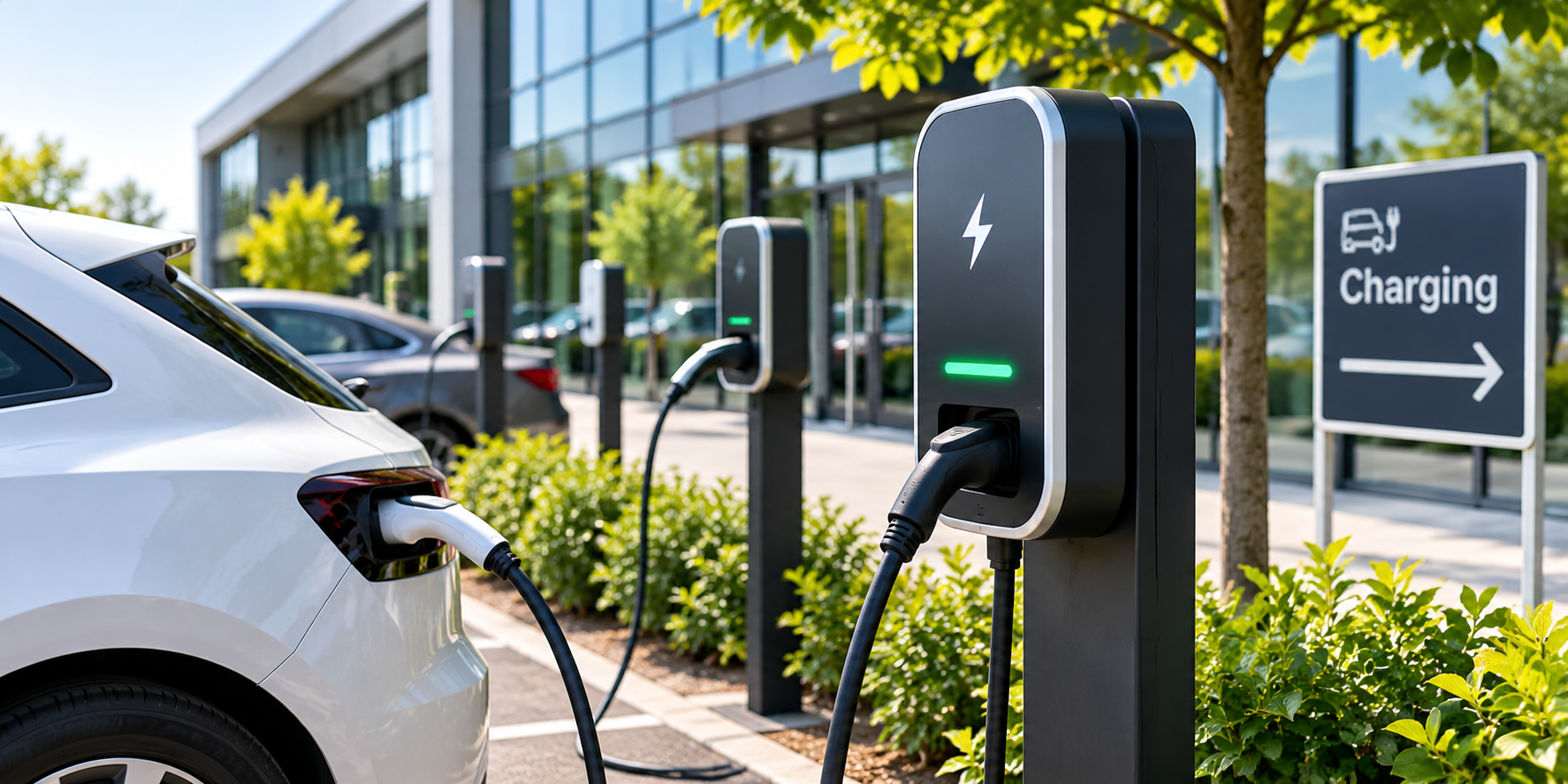
Commercial EV charging enables businesses and organisations to provide dedicated electric vehicle charging facilities for employees, customers, visitors and company fleets. From a small workplace with two charging points to a large commercial car park, a professionally designed charging installation can support the transition to electric vehicles while meeting the operational needs of your business.
Who Can Benefit from Commercial EV Charging?
Commercial charging solutions can be tailored to different business environments, parking arrangements and vehicle charging requirements.
- Offices and workplaces: Convenient charging facilities for employees and visitors.
- Hotels and hospitality venues: Charging facilities for guests during their stay.
- Retail centres and supermarkets: Customer charging while shopping.
- Warehouses and distribution centres: Charging infrastructure for electric commercial vehicles.
- Fleet depots: Dedicated charging for company cars, vans and operational vehicles.
- Commercial car parks: Charging facilities with optional payment and access management.
Commercial EV Charger Installation Requirements and Process
Before installing commercial EV charging equipment, an electrical contractor must assess the site's electricity supply, existing infrastructure, parking layout and anticipated charging demand. Higher-powered installations may require a three-phase supply, additional electrical capacity or approval from the local Distribution Network Operator (DNO).
The installation process typically includes:
- Site survey: Assessment of parking facilities, electrical infrastructure and charging demand.
- System design: Selection of charging equipment, power ratings and suitable locations.
- Network assessment: Electricity supply evaluation and DNO approval or notification where required.
- Infrastructure preparation: Groundworks, cable routes and electrical distribution equipment.
- Charger installation: Installation of charging stations and associated protective equipment.
- Testing and certification: Electrical safety checks, commissioning and documentation.
- System configuration: Payment systems, user access, software integration and operational handover.
Installations should comply with applicable electrical safety standards, including BS 7671 and relevant workplace electrical safety requirements. Publicly accessible charging facilities may also be subject to additional payment, accessibility and operational regulations.
Commercial EV Charging Grants
The government's Workplace Charging Scheme (WCS) provides financial support to eligible businesses, charities and public sector organisations towards the purchase and installation of electric vehicle charging equipment.
Workplace Charging Scheme Grant details
| Workplace Charging Scheme | Grant details |
|---|---|
| Maximum funding per socket | £500 |
| Maximum contribution | 75% of eligible costs |
| Maximum number of sockets | 40 per applicant |
| Maximum potential funding | £20,000 |
| Scheduled scheme closing date | 31 March 2027 |
Applicants must meet the scheme's eligibility requirements and use an OZEV-authorised installer with eligible charging equipment. Not every commercial charging installation qualifies for funding. GOV.UK+2
Visit the government EV chargepoint grants website for current eligibility requirements and funding information.
Smart Charging and Commercial Chargepoint Management
Modern commercial EV charging systems offer intelligent software that allows businesses to manage multiple charging points, control electricity consumption and monitor charging activity from a central platform.
| Feature | Benefit |
|---|---|
| Dynamic load management | Distributes available electricity between charging vehicles |
| RFID access control | Restricts charging to authorised users |
| Payment integration | Enables paid charging sessions |
| Remote monitoring | Tracks charger availability and operational status |
| Energy reporting | Monitors electricity consumption and charging costs |
| OCPP compatibility | Enables integration with compatible charging management platforms |
| Solar integration | Utilises available renewable electricity |
| Charging schedules | Optimises charging around operational requirements |
Businesses can choose between free charging, subsidised employee charging or paid charging, depending on their commercial objectives.
Questions
Frequently asked questions
How long does commercial EV charger installation take?
A small commercial installation may take one or two days, while larger projects involving multiple charging stations, groundworks and electrical supply upgrades may take several weeks. Network approval and equipment delivery can extend the overall project timeframe
Can businesses charge employees and customers for electricity?
Yes. Compatible commercial charging systems allow businesses to set charging prices, manage payments and provide different tariffs for employees, visitors and customers.
Do commercial EV chargers require a three-phase electricity supply?
Not all commercial chargers require three-phase electricity. However, 11kW and 22kW AC chargers generally require a suitable three-phase supply, while DC charging stations typically require greater electrical capacity.
Can commercial EV chargers be connected to solar panels?
Yes. Compatible charging systems can integrate with commercial solar PV installations and battery storage, helping businesses make better use of renewable electricity.
Do commercial EV chargers require maintenance?
Regular inspection, electrical testing, software updates and preventative maintenance help maintain charging reliability and electrical safety. Maintenance requirements depend on equipment type, usage and manufacturer recommendations.
Can additional charging points be installed later?
Yes. Designing the initial installation with sufficient electrical capacity, cable infrastructure and scalable load management can make future expansion easier and potentially reduce additional installation costs.
Do I need planning permission for commercial EV chargers?
Planning requirements depend on the installation's location, equipment dimensions, associated infrastructure and property restrictions. Some installations may qualify as permitted development, while larger projects may require planning permission.
Free and no obligation
Compare up to 5 free quotes from local EV charger installers
Enter your postcode and we'll connect you with vetted, local installers.
Get Free QuotesExplore more locations