
Charging facilities for employees
Workplace EV Charging
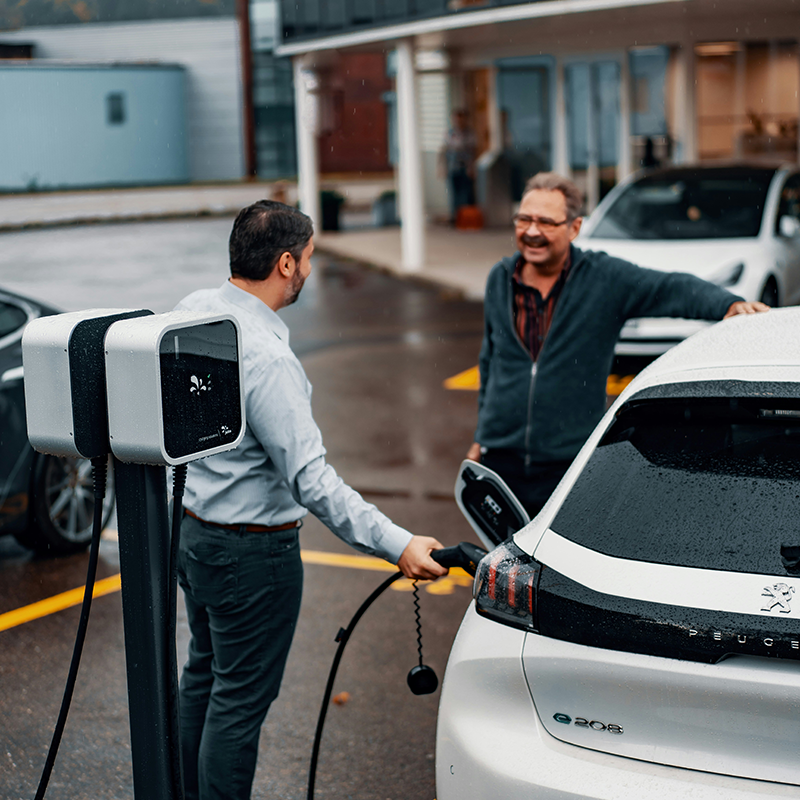
Workplace EV charging allows businesses to provide convenient electric vehicle charging facilities for employees, visitors and company vehicles. Installing dedicated charging points at work can support sustainable commuting, reduce reliance on public charging stations and help businesses prepare for the growing adoption of electric vehicles. From small offices to large corporate premises, workplace charging solutions can be designed around employee demand, parking capacity and available electrical infrastructure.
Benefits of Installing EV Chargers at Work
Workplace EV charging can provide practical and financial benefits for both employers and employees, while supporting wider corporate sustainability objectives.
- Employee satisfaction: Offer convenient charging during working hours.
- Lower commuting costs: Provide access to potentially cheaper charging.
- Employee retention: Introduce an additional workplace benefit.
- Sustainability: Encourage lower-emission commuting.
- Fleet electrification: Support the transition to electric company vehicles.
- Revenue opportunities: Recover electricity costs through paid charging.
- Future readiness: Prepare workplace infrastructure for increasing EV adoption.
Choosing the Right Workplace EV Chargers
AC chargers are generally the most practical solution for workplaces because employees typically leave their vehicles parked for several hours. The ideal charging power depends on employee working hours, vehicle requirements and the property's electrical capacity.
| Charging power | Estimated range per hour | Suitable for |
|---|---|---|
| 3.6kW | 11 miles | Long-stay employee parking |
| 7kW | 22 miles | Standard workplace charging |
| 11kW | 35 miles | Company cars and workplaces |
| 22kW | 69 miles | Shared charging and shorter stays |
| 50kW DC | 158 miles | High-demand fleet operations |
Estimated range based on 3.5 miles/kWh and 90% charging efficiency. Actual performance depends on vehicle compatibility and available charging power.
For most office environments, 7kW or 22kW AC chargers with dynamic load management offer a practical balance between installation costs and charging capacity.
How Much Does Workplace EV Charger Installation Cost?
Workplace EV charger installation costs depend on the number of charging points, charger specifications, electrical supply capacity, cable distances and any additional infrastructure required.
| Installation type | Estimated cost |
|---|---|
| Single 7kW workplace charger | £1,000–£2,000 |
| Single 22kW workplace charger | £1,500–£3,500 |
| Dual-socket charging station | £2,500–£5,000 |
| Four AC charging sockets | £5,000–£10,000 |
| Eight AC charging sockets | £10,000–£20,000 |
| Large workplace charging network | Site-specific quotation |
Prices are indicative budgeting estimates. VAT, major electrical upgrades, groundworks and ongoing management software fees may be additional.
Learn more about commercial EV charging solutions and the factors affecting larger charging installations.
Workplace Charging Scheme and Government Grants
The Workplace Charging Scheme (WCS), administered by the Office for Zero Emission Vehicles (OZEV), provides financial assistance to eligible businesses, charities and public sector organisations towards the purchase and installation of workplace EV charging equipment.
| Workplace Charging Scheme | Grant details |
|---|---|
| Maximum funding per socket | £500 |
| Maximum contribution | 75% of eligible costs |
| Maximum number of sockets | 40 per applicant across all sites |
| Maximum potential funding | £20,000 |
| Scheduled scheme closing date | 31 March 2027 |
Businesses must meet the relevant eligibility requirements, have suitable off-street parking and use an OZEV-authorised installer with approved charging equipment. A grant voucher must be obtained before installation. More info
Visit the official Workplace Charging Scheme guidancefor further information
Managing Employee EV Charging
Smart workplace charging systems allow employers to control charger access, monitor electricity consumption and manage charging across multiple vehicles. Businesses can provide free charging as an employee benefit, introduce subsidised charging rates or recover electricity costs through a paid charging system.
| Management feature | Benefit |
|---|---|
| RFID cards | Employee identification and charging access |
| Charging tariffs | Set employee and visitor charging rates |
| Dynamic load management | Distribute available electrical capacity |
| Remote management | Monitor charging equipment and availability |
| Energy reporting | Track individual charging consumption |
| Solar integration | Utilise surplus renewable electricity |
| Charging schedules | Manage charging around working hours |
Choosing scalable charging equipment and management software can also make it easier to accommodate additional electric vehicles in the future.
Workplace EV Charger Installation Process
Before installing workplace EV chargers, an electrical contractor must assess the existing electricity supply, parking arrangements, expected charging demand and potential future expansion requirements.
The installation process typically includes:
- Workplace assessment: Review parking facilities and employee charging requirements.
- Electrical survey: Assess available electrical capacity and existing infrastructure.
- System design: Determine charger locations, power ratings and load management requirements.
- Installation: Fit charging equipment, cabling and electrical protection.
- Testing and certification: Complete electrical safety checks and commissioning.
- System configuration: Set up employee access, charging tariffs and management software.
Always choose a suitably qualified electrical contractor with relevant commercial EV charging experience. Professional registration with organisations such as NICEIC or NAPIT can provide additional reassurance.
Questions
Frequently asked questions
How many EV chargers does a workplace need?
The number of chargers depends on employee demand, working hours, parking capacity and expected electric vehicle adoption. Businesses can start with a smaller installation and expand as demand increases.
Can employers charge employees for EV charging?
Yes. Compatible workplace charging systems allow employers to offer free, subsidised or fully paid charging sessions.
Is workplace EV charging a taxable employee benefit?
Free workplace charging for employees' own electric vehicles can qualify for a benefit-in-kind tax exemption, provided the applicable HMRC conditions are met.
Can EV chargers be installed at rented business premises?
Yes, subject to landlord permission, suitable parking arrangements and electrical installation requirements.
How long does workplace EV charger installation take?
Small installations may take one or two days, while larger projects involving groundworks or electrical supply upgrades may take considerably longer.
Can workplace EV chargers be powered by solar panels?
Yes. Compatible charging equipment can be integrated with commercial solar panels and battery storage systems to make better use of renewable electricity.
Can we expand our workplace charging facilities later?
Yes. Installing scalable electrical infrastructure and dynamic load management from the outset can simplify future expansion.
Free and no obligation
Compare up to 5 free quotes from local EV charger installers
Enter your postcode and we'll connect you with vetted, local installers.
Get Free QuotesExplore more locations