Usage and cost
7kW vs 22kW EV Chargers: What's the Difference?
When choosing a home EV charger, one of the biggest decisions is whether to install a 7kW or 22kW charging point. At first glance, a 22kW charger might seem like the obvious choice. After all, it offers three times the rated charging power of a 7kW charger. However, most UK homes have a single-pha
By PickASparky Team
15 min read
When choosing a home EV charger, one of the biggest decisions is whether to install a 7kW or 22kW charging point.
At first glance, a 22kW charger might seem like the obvious choice. After all, it offers three times the rated charging power of a 7kW charger.
However, most UK homes have a single-phase electricity supply, and many electric vehicles cannot accept 22kW AC charging. This means a more powerful charger will not necessarily charge your car any faster.
For many households, a 7kW charger is the more practical and economical option.
In this guide, we compare 7kW and 22kW EV chargers, explain their electrical requirements, look at charging times and help you decide which option is best for your property.
What Is the Difference Between a 7kW and 22kW EV Charger?
The main difference is the amount of electrical power each charger can deliver.
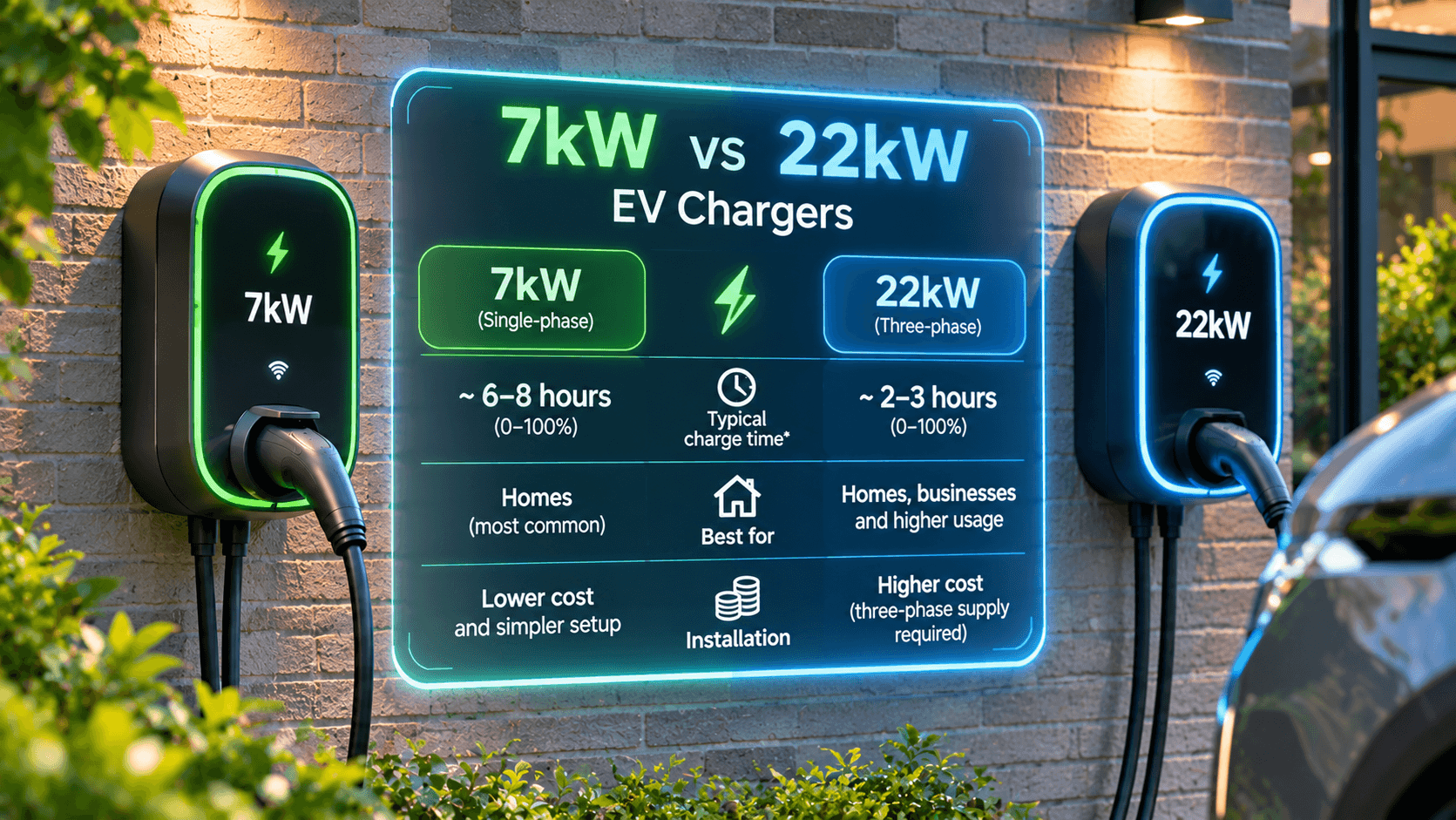
A 7kW charger typically operates using a single-phase electricity supply, while a 22kW charger requires a suitable three-phase supply.
The higher power rating of a 22kW charger means it can potentially deliver energy to a compatible electric vehicle much faster.
However, the actual charging speed depends on several factors, including the vehicle's onboard charger, the property's electrical supply and any power limits applied during charging.
7kW vs 22kW EV Charger Comparison
| Feature | 7kW EV Charger | 22kW EV Charger |
|---|---|---|
| Rated charging power | Approximately 7kW | Up to 22kW |
| Electricity supply | Single-phase | Three-phase |
| Common in UK homes | Yes | Less common |
| Maximum theoretical energy in one hour | 7kWh | 22kWh |
| Typical installation complexity | Generally lower | Potentially higher |
| Vehicle compatibility | Widely supported | Full speed requires 22kW AC capability |
| Best suited for | Most domestic properties | Suitable three-phase properties and compatible vehicles |
| Potential charging speed | Around 25–30 miles of range per hour | Up to approximately 60–90 miles per hour for compatible vehicles |
Range figures are approximate and depend on vehicle efficiency, charging losses and the power actually delivered. A 22kW charger does not guarantee 22kW charging.
The key consideration is not simply which charger has the highest power rating, but which one your home and vehicle can actually use.
How Fast Is a 7kW EV Charger?
A 7kW home charger is a common choice for UK households because it provides relatively fast charging using a suitable single-phase electricity supply.
In ideal conditions, a charger delivering 7kW for one hour supplies approximately 7kWh of electricity.
Allowing for charging losses, the energy stored in the vehicle's battery will be slightly lower.
For an electric vehicle averaging approximately 3.5 miles per kWh, a 7kW charger might add around 22 miles of driving range per hour at 90% charging efficiency.
Actual results vary depending on the vehicle and charging conditions.
How Long Does a 7kW Charger Take to Charge an EV?
The time required depends on how much energy needs to be added to the battery.
For example, charging a 60kWh battery from 20% to 80% requires approximately 36kWh of battery energy.
At 90% charging efficiency, the charger would need to draw approximately 40kWh from the electricity supply.
At a sustained 7kW charging rate:
40 ÷ 7 = approximately 5.7 hours.
This means a 7kW charger could complete that charging session in around six hours under the stated assumptions.
For many drivers, this fits comfortably into an overnight charging routine.
If you're considering the ongoing electricity expenses, our guide to how much it costs to charge an electric car at home explains how charging efficiency, battery capacity and electricity prices affect running costs.
How Fast Is a 22kW EV Charger?
A 22kW charger can theoretically deliver up to 22kWh of electricity in one hour.
This is approximately three times the rated power of a 7kW charger.
However, achieving that charging speed requires both a suitable three-phase electricity supply and a vehicle capable of accepting 22kW AC charging.
Many electric vehicles have onboard AC chargers limited to approximately 7kW or 11kW.
If your car can accept only 11kW AC charging, connecting it to a 22kW charging point will generally result in a maximum charging rate of around 11kW, not 22kW.
Similarly, a vehicle limited to approximately 7kW AC charging will not suddenly charge at 22kW simply because the charging point is more powerful.
How Long Does a 22kW Charger Take to Charge an EV?
Using the same example of a 60kWh battery charged from 20% to 80%, approximately 40kWh would need to be drawn from the electricity supply at 90% efficiency.
At a sustained 22kW charging rate:
40 ÷ 22 = approximately 1.8 hours.
Under ideal conditions, this charging session could therefore take around two hours.
However, this calculation only applies if the vehicle can accept the full charging power and the installation can supply it.
A car with an 11kW onboard AC charger would take approximately 3.6 hours under the same assumptions.
7kW vs 22kW Charging Times
To understand the difference more clearly, consider how long it might take to add 40kWh of electricity to an EV battery.
Assuming 90% charging efficiency, approximately 44.4kWh would need to be purchased from the electricity supply.
| Actual Charging Power | Approximate Charging Time |
|---|---|
| 3.6kW | 12.3 hours |
| 7kW | 6.3 hours |
| 11kW | 4.0 hours |
| 22kW | 2.0 hours |
Illustrative charging times assuming sustained charging power and 90% efficiency. Actual charging speeds may vary.
Although the difference between 7kW and 22kW is substantial, most drivers do not need to recharge a nearly empty battery every day.
For a typical daily journey, a 7kW charger may provide more than enough charging capacity overnight.
What Is Single-Phase Electricity?
Most UK residential properties use a single-phase electricity supply.
Single-phase electricity is commonly used to power domestic appliances, lighting, heating systems and other household electrical equipment.
A typical 7kW home EV charger draws approximately 30–32 amps from a suitable single-phase supply.
However, the available capacity depends on the property's electrical installation and existing electricity demand.
Before installing a charger, an electrician must assess whether the supply can safely accommodate the additional load.
In some cases, dynamic load management may be required to prevent the property's electrical demand from exceeding its available capacity.
What Is Three-Phase Electricity?
Three-phase electricity uses three alternating electrical phases to distribute electrical power.
It is commonly found in commercial and industrial buildings, although some residential properties also have three-phase supplies.
A 22kW AC charger typically draws approximately 32 amps on each phase.
Because the load is distributed across three phases, the installation can deliver substantially more power than a typical single-phase domestic charging point.
However, having a three-phase supply does not automatically mean a property can support a 22kW charger without additional assessment.
The electrician must still consider available capacity, existing electrical demand, protective equipment and network requirements.
Can You Install a 22kW EV Charger at Home in the UK?
Yes, it is possible to install a 22kW EV charger at a residential property, provided the electrical supply and installation are suitable.
However, most UK homes do not already have the three-phase supply normally required for a 22kW AC charger.
If your property has only single-phase electricity, installing a 22kW charger at its full rated output would generally require upgrading to a suitable three-phase supply.
This may involve work by the local electricity distribution network operator.
How Much Does a Three-Phase Electricity Upgrade Cost?
There is no single standard price for upgrading a property from single-phase to three-phase electricity.
The cost depends on several factors, including:
- The existing electricity connection.
- The local distribution network's available capacity.
- The distance to suitable network infrastructure.
- Whether excavation or new cabling is required.
- The property's location and accessibility.
- Any changes needed to the property's electrical installation.
Some upgrades may be relatively straightforward, while others can involve substantial engineering work and considerable expense.
Before committing to a 22kW charger, request an assessment from the relevant electricity network operator and a qualified electrician.
For most households, the additional cost of obtaining three-phase electricity may be difficult to justify solely for faster home EV charging.
How Much Does It Cost to Install a 7kW or 22kW Charger?
The installation cost depends on the charger itself and the electrical work required.
As a general UK guide, a straightforward home EV charger installation may cost approximately £800 to £1,200, including equipment and standard installation.
However, this indicative range is more representative of conventional domestic installations than complex three-phase projects.
7kW Charger Installation Costs
A 7kW charger is often the more economical option because it can usually be installed using a suitable existing single-phase supply.
The final price depends on:
- Charger brand and features.
- Distance from the consumer unit.
- Existing electrical protection.
- Cable routing and accessibility.
- Additional electrical work.
- Groundworks or external mounting requirements.
22kW Charger Installation Costs
A 22kW installation may involve higher equipment and electrical installation costs.
If the property already has a suitable three-phase supply, installation may be relatively straightforward.
However, if a three-phase upgrade is required, the total project cost can increase significantly.
For a detailed breakdown of equipment prices, electrical upgrades and installation extras, read our guide to EV charger installation costs in the UK.
Do All Electric Cars Support 22kW Charging?
No. Not all electric vehicles support 22kW AC charging.
This is one of the most important factors to consider before purchasing a more powerful home charger.
Electric vehicles contain an onboard charger that converts alternating current (AC) electricity into direct current (DC) for storage in the battery.
The onboard charger determines the maximum AC charging power the vehicle can accept.
Common onboard AC charging limits include approximately:
- 3.6kW.
- 7kW or 7.4kW.
- 11kW.
- 22kW.
The exact rating depends on the vehicle model and specification.
For example, an electric car with an 11kW onboard charger will generally charge at no more than 11kW when connected to a 22kW AC charging point.
Before choosing a charger, check your vehicle manufacturer's specifications for its maximum AC charging capacity.
Is AC Charging Different From DC Rapid Charging?
Yes.
Home EV chargers normally supply AC electricity, which the vehicle's onboard charger converts into DC electricity.
Public rapid and ultra-rapid charging stations generally deliver DC electricity directly to the vehicle's battery system.
This allows compatible vehicles to charge at much higher power levels than their onboard AC chargers would permit.
A vehicle capable of accepting 150kW DC charging may still be limited to 11kW when connected to an AC charger.
The two charging ratings should not be confused.
Is a 22kW Charger More Expensive to Run?
Not necessarily.
Electricity suppliers generally charge for the amount of energy consumed, measured in kilowatt-hours (kWh), rather than the charger's maximum power rating.
For example, purchasing 40kWh of electricity at 10p per kWh costs £4, regardless of whether it is delivered through a 7kW or 22kW charger.
However, actual charging losses can vary depending on charging power, vehicle efficiency and other conditions.
A more powerful charger may also complete charging outside a discounted electricity window if charging schedules are not configured correctly.
Can You Use an Overnight EV Tariff With Either Charger?
Yes, provided the charger, vehicle and electricity tariff meet the supplier's requirements.
Many UK electricity suppliers offer discounted overnight rates for EV owners.
A 7kW charger can often replenish enough energy during an overnight off-peak period for typical daily driving needs.
A 22kW charger may complete charging more quickly, but that advantage is only useful if the vehicle and electrical supply support the higher power.
Our guide to the best EV electricity tariffs in the UK explains how discounted charging windows work and how to compare total household electricity costs.
Is a 22kW Charger Better for Future-Proofing?
Some homeowners consider installing a 22kW charger to prepare for future electric vehicles.
This can make sense if the property already has a suitable three-phase supply and the additional equipment cost is reasonable.
However, future-proofing should be considered alongside actual charging requirements.
A 7kW charger can already provide substantial overnight charging for many households.
Even if a future vehicle supports 22kW AC charging, faster charging may offer limited practical benefits if the car is parked at home for eight or more hours every night.
It is also worth remembering that charging technology, vehicle compatibility and electricity tariffs may change over time.
Rather than automatically choosing the most powerful charger, consider whether the additional capacity is likely to provide a meaningful benefit.
Which EV Charger Is Best for Your Home?
The best choice depends on your property's electrical supply, your vehicle and your daily driving requirements.
Choose a 7kW Charger If:
- Your property has a single-phase electricity supply.
- You normally charge your vehicle overnight.
- Your daily mileage is relatively modest.
- You want a practical home charging solution without unnecessary electrical upgrades.
- Your vehicle cannot accept more than approximately 7kW AC charging.
Consider a 22kW Charger If:
- Your property already has a suitable three-phase supply.
- Your electric vehicle supports 22kW AC charging.
- You regularly need to recharge substantial amounts of energy in a short period.
- Multiple compatible vehicles or demanding charging schedules justify the additional capacity.
- The extra installation cost is reasonable for your circumstances.
For most UK households, a 7kW charger is likely to be sufficient.
However, a qualified installer should assess your electrical supply and charging requirements before recommending a particular charger.
Can Solar Panels Work With 7kW and 22kW Chargers?
Yes. Some EV chargers can integrate with domestic solar photovoltaic systems.
Solar-compatible chargers can monitor surplus electricity generation and adjust charging power to make use of available solar energy.
However, the amount of solar electricity generated by a typical domestic system is often substantially lower than the maximum power of a 22kW charger.
This means a 22kW charger will not automatically provide an advantage when charging from solar panels.
The most important features are usually solar integration, adjustable charging power and compatibility with the property's electrical system.
If you're considering combining solar generation with EV charging, read our guide to charging an electric car using solar panels.
Frequently Asked Questions
Is a 22kW EV Charger Three Times Faster Than a 7kW Charger?
Potentially, but only when the vehicle can accept 22kW AC charging and the electrical installation can supply that power. Many vehicles are limited to 7kW or 11kW AC charging, so a 22kW charger may not deliver its full rated output.
Can I Install a 22kW Charger With Single-Phase Electricity?
A conventional 22kW AC charger requires a suitable three-phase supply to operate at its full rated power. Some three-phase charger models can operate at reduced power on single-phase electricity, but this does not provide 22kW charging.
Is a 7kW Charger Fast Enough for Home Charging?
For many households, yes. A 7kW charger can replenish a substantial amount of battery energy overnight, making it suitable for typical daily driving requirements.
Does a 22kW Charger Use More Electricity?
Not simply because it has a higher power rating. The total electricity consumed depends mainly on how much energy is added to the vehicle and charging losses. A 22kW charger can deliver energy more quickly when the vehicle supports it.
Can a Tesla Charge at 22kW AC?
Tesla AC charging capability varies by model and specification. Many modern Tesla vehicles sold in the UK support up to approximately 11kW AC charging, meaning a 22kW AC charger would not necessarily provide faster charging. Check the specifications for your particular vehicle.
Do I Need Permission to Install a 22kW Charger?
A 22kW installation may require advance approval from the relevant electricity distribution network operator. The installer must assess the connection and follow applicable notification or approval requirements.
Is a 22kW Charger Worth the Extra Money?
It can be worthwhile for properties with suitable three-phase electricity and vehicles capable of accepting the higher charging power. For most single-phase households, a 7kW charger is generally the more practical and economical choice.
Compare EV Charger Installation Quotes
Choosing between a 7kW and 22kW charger is not simply about charging speed.
Your property's electrical supply, vehicle compatibility, installation costs and everyday charging habits all influence which option makes the most sense.
A suitably qualified installer can assess your property and recommend an appropriate charging solution without unnecessary upgrades.
PickASparky helps you find eligible EV charger installers covering your area, making it easier to compare installation options and request quotes.