Solar panel charging
Can You Charge an Electric Car With Solar Panels? (UK Guide)
Charging an electric car using solar panels is an attractive option for homeowners who want to reduce their electricity bills and make greater use of renewable energy. Instead of purchasing all your charging electricity from the grid, you can use some of the electricity generated by solar panels in
By PickASparky Team
20 min read
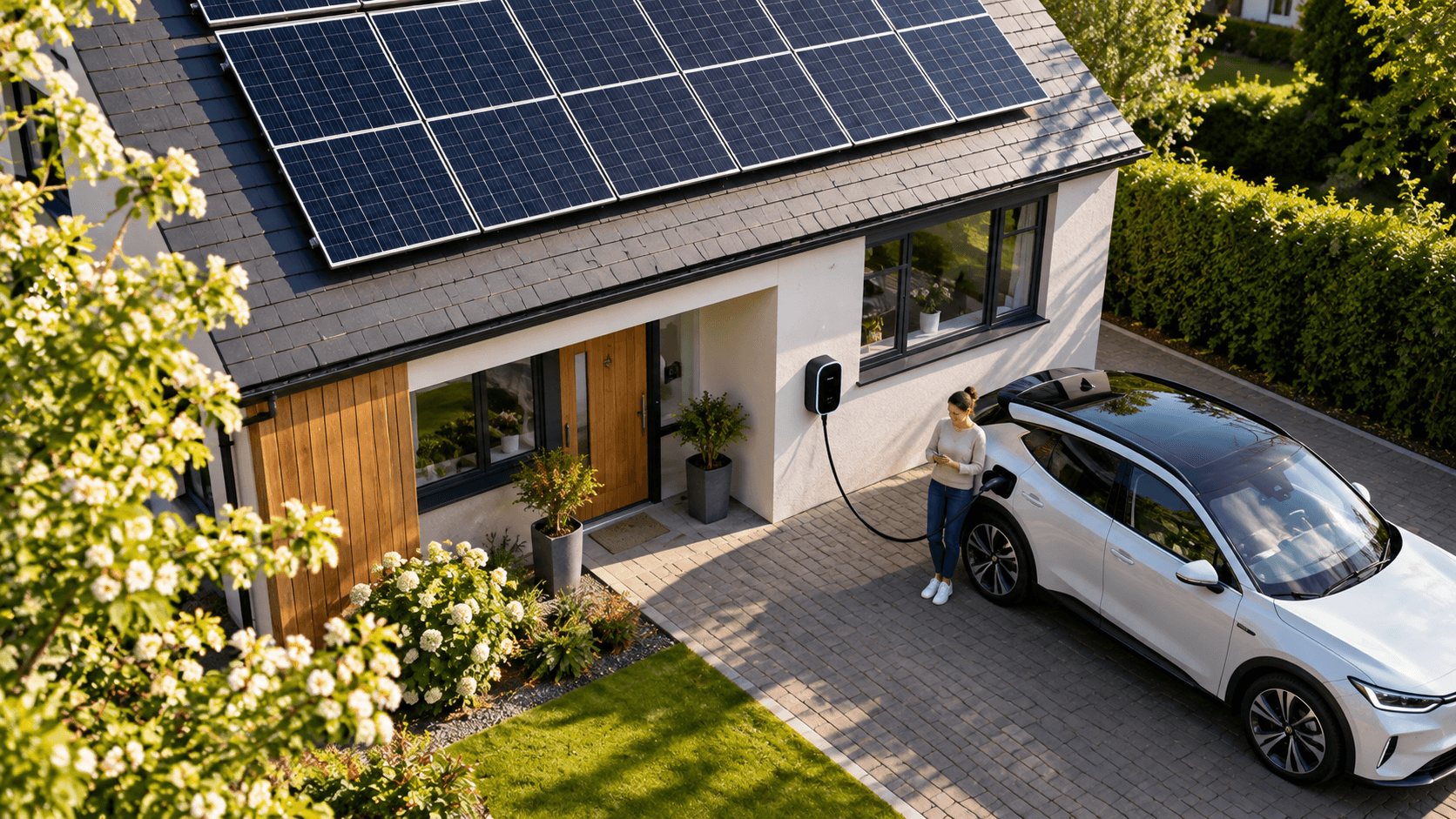
Charging an electric car using solar panels is an attractive option for homeowners who want to reduce their electricity bills and make greater use of renewable energy.
Instead of purchasing all your charging electricity from the grid, you can use some of the electricity generated by solar panels installed on your property.
But how practical is solar EV charging in the UK, particularly during winter or when your car is parked away from home during the day?
Yes, you can charge an electric car with solar panels, provided your solar installation and charging equipment are suitable. However, the amount of solar electricity available depends on the size of your system, weather conditions, household electricity consumption and when your vehicle is plugged in.
In this guide, we explain how solar EV charging works, how many panels you might need, whether battery storage is worthwhile and how much money you could potentially save.
How Does Solar EV Charging Work?
Solar panels generate direct current (DC) electricity when exposed to sunlight.
A solar photovoltaic (PV) inverter converts this electricity into alternating current (AC), which can be used by household appliances and a conventional home EV charger.
When your solar panels generate electricity, that energy can be used by your home, including your electric vehicle.
If your solar system generates more electricity than your household currently needs, the surplus may be available for EV charging.
A compatible smart EV charger can monitor this surplus generation and adjust the vehicle's charging power accordingly.
This helps maximise the amount of solar electricity used at home rather than exported to the grid.
Solar EV Charging: How Electricity Flows
A typical solar EV charging setup works as follows:
- Solar panels generate electricity from sunlight.
- A solar inverter converts the generated electricity into usable AC electricity.
- Household appliances consume some of the available electricity.
- A compatible EV charger monitors available surplus solar generation.
- The charger adjusts charging power according to the available electricity.
- Any remaining surplus may be exported to the electricity grid or stored in a home battery.
The exact arrangement depends on the solar inverter, EV charger, electricity meter and any battery storage equipment.
Not every EV charger supports automatic surplus solar charging, so compatibility should be checked before purchasing equipment.
Can Solar Panels Fully Charge an Electric Car?
Yes, solar panels can potentially provide enough electricity to fully charge an electric car.
However, this does not mean every solar installation can fully charge every EV directly from sunlight in a single day.
The amount of energy required depends on the vehicle's battery capacity and its existing state of charge.
For example, charging a 60kWh battery from 20% to 80% requires approximately 36kWh of energy stored in the battery.
Allowing for charging losses, the electricity required from the solar system may be closer to 40kWh.
Generating this amount of surplus electricity in a single day would be difficult for many typical domestic solar installations, particularly during winter.
However, most drivers do not need to fully recharge an empty battery every day.
If you only need to replace the electricity used during normal daily journeys, solar charging may be much more practical.
How Much Electricity Does an Electric Car Use?
Electric vehicle efficiency varies by model, driving conditions and temperature.
For illustration, consider an electric car averaging 3.5 miles per kWh of battery energy.
| Daily Driving Distance | Approximate Battery Energy Used |
|---|---|
| 10 miles | 2.9kWh |
| 20 miles | 5.7kWh |
| 30 miles | 8.6kWh |
| 40 miles | 11.4kWh |
| 50 miles | 14.3kWh |
These are illustrative figures based on 3.5 miles per kWh. Additional electricity will be required to account for charging losses.
For someone driving 20 miles per day, replacing approximately 5.7kWh of battery energy may be achievable using surplus solar generation on a suitable sunny day.
However, the actual amount available depends on the solar system and household demand.
How Many Solar Panels Do You Need to Charge an Electric Car?
There is no single number of solar panels that every EV owner needs.
The answer depends on several factors:
- Your annual driving mileage.
- The efficiency of your electric vehicle.
- The power rating of your solar panels.
- Your roof's orientation and shading.
- Your location within the UK.
- Seasonal solar generation.
- Household electricity consumption.
- Whether you can charge during daylight hours.
A solar panel rated at 450 watts has a peak output of 0.45kW under standard test conditions.
Ten such panels would provide a solar array with a rated capacity of 4.5kWp.
However, a 4.5kWp system does not continuously generate 4.5kW throughout the day.
Actual output changes with sunlight, weather, temperature and other conditions.
Example: Annual EV Electricity Requirements
Suppose you drive 10,000 miles per year in an electric car averaging 3.5 miles per kWh.
Your vehicle would use approximately:
10,000 ÷ 3.5 = 2,857kWh of battery energy annually.
Assuming 90% charging efficiency, the electricity required for charging would be approximately:
2,857 ÷ 0.90 = 3,175kWh per year.
This is the approximate annual electricity consumption associated with charging the vehicle.
However, generating 3,175kWh of solar electricity annually does not mean that all of it will be available for EV charging.
Some electricity will be consumed by household appliances, while some may be generated when the vehicle is not connected.
How Much Electricity Can a Solar System Generate?
A well-positioned domestic solar PV system in the UK may generate roughly 800–1,000kWh annually per installed kWp, although actual generation varies considerably.
For example:
| Solar System Size | Illustrative Annual Generation |
|---|---|
| 2kWp | 1,600–2,000kWh |
| 3kWp | 2,400–3,000kWh |
| 4kWp | 3,200–4,000kWh |
| 5kWp | 4,000–5,000kWh |
| 6kWp | 4,800–6,000kWh |
Illustrative annual generation ranges, not guaranteed output. Actual results depend on location, orientation, shading, equipment and weather.
A 4kWp solar system might generate a similar amount of electricity over a year to the annual charging requirement in our 10,000-mile example.
However, much of that generation may not coincide with the times when the car is available to charge.
This is why solar self-consumption and charging schedules are just as important as the number of panels installed.
Do You Need a Special EV Charger for Solar Panels?
You do not necessarily need a specialist solar EV charger to use electricity generated by your solar panels.
If your home has solar PV and a conventional EV charger, the charger can use electricity available within the property's electrical system.
However, a standard charger may draw additional electricity from the grid when solar generation is insufficient.
A solar-compatible smart charger can offer more control.
What Is a Solar-Compatible EV Charger?
A solar-compatible charger can monitor electricity generation and household consumption, then adjust vehicle charging to make use of available surplus solar energy.
Depending on the charger, features may include:
- Surplus solar charging.
- Automatic charging power adjustment.
- Solar and grid charging modes.
- Scheduled overnight charging.
- Energy consumption monitoring.
- Integration with home battery systems.
- Smart electricity tariff compatibility.
Some chargers use additional monitoring equipment, such as current transformers or compatible energy meters, to measure electricity flows.
Before purchasing equipment, check whether the charger supports your existing solar inverter and electrical installation.
What Is Solar Surplus Charging?
Solar surplus charging means using electricity that would otherwise be exported to the grid to charge your electric vehicle.
For example, imagine your solar panels are generating 4kW of electricity.
Your household is currently using 1kW.
This leaves approximately 3kW of surplus solar generation.
A compatible smart charger may be able to direct that surplus electricity towards your vehicle.
If cloud cover reduces solar generation, the charger can lower its charging power or pause charging, depending on its capabilities and settings.
Can an EV Charge Using Only Solar Electricity?
Potentially, yes.
Some smart chargers offer modes designed to minimise or avoid importing electricity from the grid.
However, AC charging has minimum operating current requirements.
For a typical single-phase charging arrangement, the minimum charging current is approximately 6 amps, corresponding to roughly 1.4kW at 230 volts.
If surplus solar generation falls below the minimum required charging power, the charger may pause charging or supplement it with grid electricity, depending on its configuration.
This means solar-only charging is not always possible during cloudy conditions or periods of low generation.
Can You Charge an EV With Solar Panels in Winter?
Yes, but solar electricity generation is generally much lower during UK winter months.
Shorter daylight hours, lower sun angles and more frequent cloudy weather reduce the amount of electricity generated.
A solar system that produces substantial surplus electricity during summer may produce relatively little during December or January.
As a result, you may need to rely more heavily on grid electricity during winter.
Summer vs Winter Solar Charging
Consider a hypothetical 4kWp solar installation.
On a favourable summer day, the system might generate 20kWh or more.
On a dull winter day, generation could be only a few kilowatt-hours.
These are illustrative examples rather than forecasts for a particular property.
The important point is that solar EV charging varies throughout the year.
For most UK households, solar panels are best viewed as a way to reduce grid electricity consumption rather than guarantee completely solar-powered driving every day.
Do You Need a Home Battery to Charge an EV With Solar Panels?
No. A home battery is not required for solar EV charging.
If your electric car is parked at home during daylight hours, it may be able to use surplus solar electricity directly.
However, battery storage can provide additional flexibility.
A home battery stores electricity generated during the day so that it can be used later.
This may be useful if you are away from home during the day and return in the evening.
Can a Home Battery Charge an Electric Car Overnight?
Yes, provided the battery system, inverter and electrical installation support the required power and energy transfer.
However, domestic batteries are usually much smaller than electric vehicle batteries.
For example, a home battery with 10kWh of usable stored energy cannot fully charge a 60kWh EV battery.
After allowing for conversion and charging losses, the amount of energy transferred to the vehicle would be lower than the battery's nominal stored energy.
A home battery may therefore provide a useful top-up rather than a complete EV recharge.
Is Battery Storage Worth It for EV Charging?
That depends on the cost of the battery system and how you use electricity.
Battery storage can help increase solar self-consumption, but it also adds equipment costs and energy losses.
If you already have access to a very cheap overnight EV electricity tariff, purchasing a home battery solely to charge your car may not provide a strong financial return.
A proper comparison should consider:
- Battery purchase and installation costs.
- Usable storage capacity.
- Battery efficiency.
- Expected lifespan and warranty.
- Electricity import prices.
- Solar export payments.
- Household electricity consumption.
- EV charging patterns.
Battery storage may make sense as part of a wider household energy strategy, but it is not essential for solar EV charging.
How Much Does It Cost to Install Solar Panels for EV Charging?
Solar installation costs depend on the system size, roof type, equipment and complexity of the installation.
As an illustrative budgeting guide, a domestic solar PV installation in the UK may cost several thousand pounds.
For example, a 3–5kWp system might fall somewhere around £5,000–£9,000, although actual quotations can be outside this range.
This is not a verified current national average or a guaranteed installation price.
The final cost depends on factors including:
- Number and power rating of panels.
- Roof access and scaffolding.
- Inverter selection.
- Electrical installation requirements.
- Roof condition.
- Monitoring equipment.
- Battery storage.
- Installation complexity.
If you already have solar panels, adding a compatible EV charger may be considerably less expensive than installing a complete solar PV system.
How Much Does the EV Charger Cost?
A straightforward home EV charger installation may cost approximately £800–£1,200, including the charger and standard installation.
However, the final price depends on your electrical supply, cable route and any additional work.
Some solar-compatible chargers may cost more than basic models because of their additional energy management features.
Our guide to EV charger installation costs in the UK explains the main factors affecting installation prices.
Is Charging an Electric Car With Solar Panels Free?
Not entirely.
Although sunlight itself is free, generating and using solar electricity involves equipment and installation costs.
There is also an opportunity cost when you use surplus solar electricity instead of exporting it to the grid.
For example, if your electricity supplier pays you 10p per kWh for exported solar electricity, using 10kWh to charge your EV means potentially giving up £1 in export payments.
However, if importing that same electricity would cost 26p per kWh, using the solar electricity could avoid £2.60 in grid electricity purchases.
In this simplified example, the net benefit of using the solar electricity rather than exporting it is approximately £1.60.
Example: Solar EV Charging Savings
Assume:
- Grid electricity import price: 26p/kWh.
- Solar export payment: 10p/kWh.
- Surplus solar electricity used for EV charging: 1,000kWh annually.
| Scenario | Annual Value |
|---|---|
| Cost of importing 1,000kWh at 26p/kWh | £260 |
| Export income forgone at 10p/kWh | £100 |
| Net benefit of using solar instead of importing | £160 |
Illustrative calculation assuming equivalent usable electricity and excluding additional conversion losses, equipment costs and tariff conditions.
The financial benefit depends heavily on the difference between your electricity import price and solar export payment.
If you can charge your vehicle overnight at 8p per kWh while receiving 15p per kWh for exported solar electricity, exporting surplus solar during the day and charging overnight could be more financially attractive.
This is why solar EV charging should be considered alongside your electricity tariff.
Is Solar Charging Better Than an Overnight EV Tariff?
Neither option is automatically cheaper.
The answer depends on your electricity prices, export payments and charging habits.
A household with a generous solar export tariff may benefit from exporting electricity during the day and charging the vehicle overnight at a discounted rate.
Another household with a lower export payment and higher import prices may benefit more from using surplus solar electricity directly.
Example: Comparing Charging Options
| Charging Method | Illustrative Electricity Value or Cost |
|---|---|
| Standard grid electricity | 26p/kWh |
| Discounted overnight EV tariff | 8p/kWh |
| Surplus solar used instead of exporting | 10p/kWh forgone export value |
| Public charging | 50p/kWh |
These are illustrative figures. Solar opportunity cost is not directly equivalent to an electricity import tariff, and actual results depend on charging losses and contract terms.
In this example, charging overnight at 8p per kWh could be financially preferable to using surplus solar electricity that could otherwise earn 10p per kWh in export payments.
However, the comparison changes if export payments or import prices are different.
For more information, read our guide to the best EV electricity tariffs in the UK.
You can also explore our breakdown of how much it costs to charge an electric car at home.
Can a 7kW EV Charger Work With Solar Panels?
Yes.
A 7kW EV charger can be used alongside a domestic solar PV installation.
However, this does not mean the solar panels must generate 7kW continuously.
A compatible smart charger may adjust charging power according to the available solar generation.
For example, if your solar system has 3kW of surplus electricity available, the charger may be able to operate at approximately that power level, subject to the vehicle and charger's operating limits.
A 7kW charger can also draw electricity from the grid when solar generation is insufficient, depending on its settings.
Would a 22kW Charger Be Better?
Not necessarily.
A 22kW charger requires a suitable three-phase electricity supply and a vehicle capable of accepting that charging power.
Most domestic solar PV installations do not generate enough surplus electricity to operate a 22kW charger at full power using solar generation alone.
For many households, a solar-compatible 7kW charger is more practical.
Our guide to 7kW vs 22kW EV chargers explains the electrical requirements and charging speed differences.
Can You Add Solar Charging to an Existing EV Charger?
Possibly.
If you already have an EV charger, you may be able to use electricity generated by newly installed solar panels without replacing the charging point.
However, automatic surplus solar charging may require compatible monitoring equipment or additional functionality.
Some chargers support solar integration through software updates, accessories or compatible energy management systems.
Others may not support automatic solar charging at all.
Before replacing an existing charger, check the manufacturer's specifications and ask a qualified installer whether your current equipment can be integrated with the solar system.
Is Solar EV Charging Worth It in the UK?
Solar EV charging can be worthwhile, particularly for households that already have solar panels and can charge their vehicles during daylight hours.
The financial benefits depend on how much solar electricity you can use directly and what you would otherwise pay for imported electricity.
Solar EV Charging May Be Worthwhile If:
- You already have solar panels.
- Your vehicle is regularly parked at home during the day.
- You generate surplus solar electricity.
- Your electricity import rate is relatively high.
- Your solar export payment is relatively low.
- You have a compatible smart charger.
Solar EV Charging May Be Less Beneficial If:
- Your car is usually away from home during daylight hours.
- Your solar system generates little surplus electricity.
- You receive a relatively high export payment.
- You have access to very cheap overnight EV electricity.
- Installing additional equipment would be expensive.
For some households, the best solution is a combination of solar generation and a suitable overnight electricity tariff.
This allows the vehicle to use solar electricity when it makes financial sense and cheaper grid electricity when solar generation is unavailable.
How to Install an EV Charger for Solar Panels
If you're planning to combine solar panels with home EV charging, it is worth considering the complete electrical installation rather than choosing equipment separately.
Step 1: Assess Your Solar System
If you already have solar panels, identify the system's capacity, inverter model and monitoring equipment.
Consider how much surplus electricity is normally available during the day.
Step 2: Review Your Driving and Parking Habits
Estimate your daily mileage and when your vehicle is usually parked at home.
If the car is rarely available during daylight hours, direct solar charging may be limited.
Step 3: Choose a Compatible EV Charger
Look for a charger that supports your preferred solar charging features.
Check compatibility with your inverter, electrical supply and any home battery system.
Step 4: Arrange an Electrical Assessment
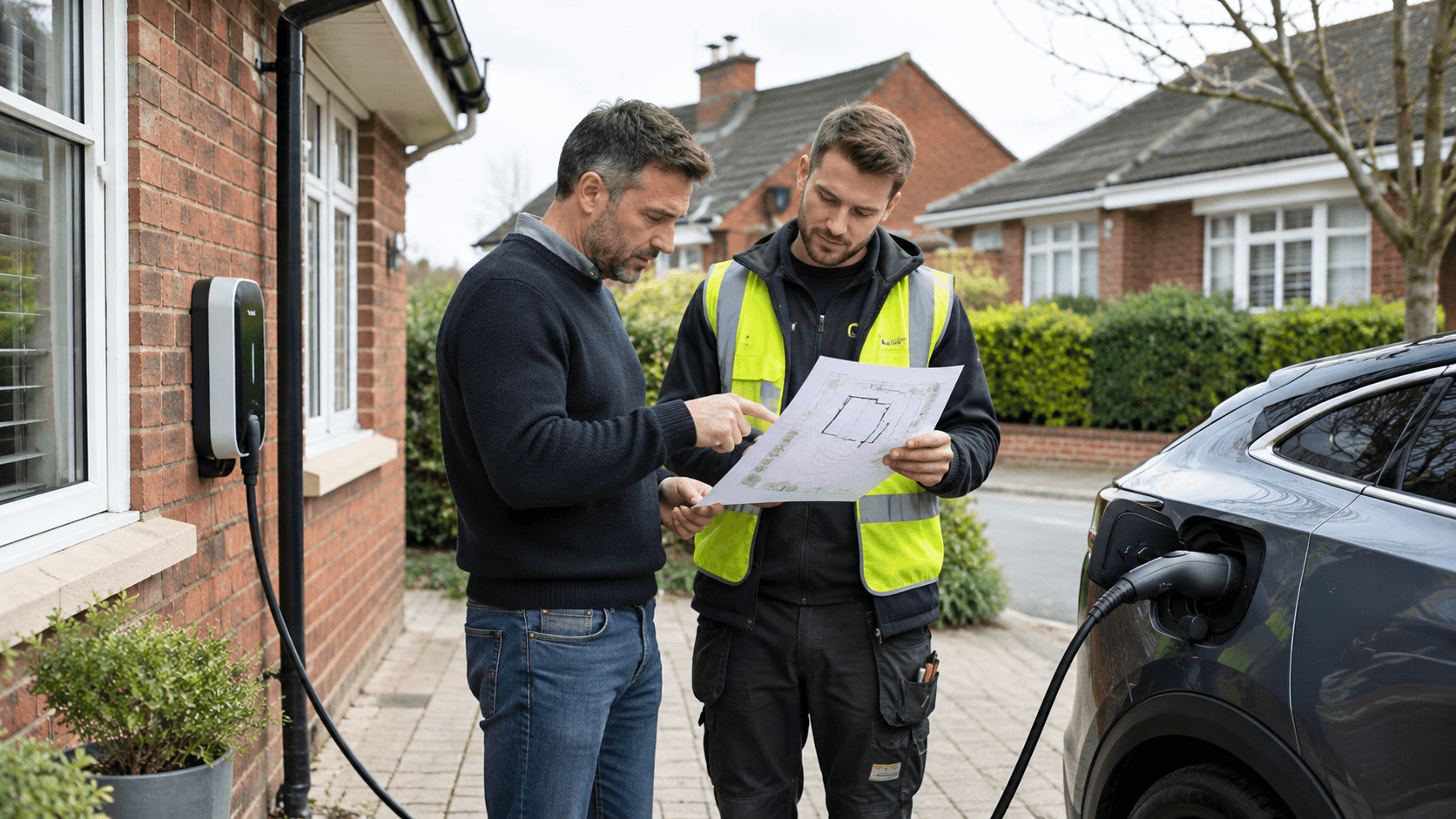
A qualified installer should assess the consumer unit, electrical supply, earthing arrangements and proposed charger location.
The installation must meet applicable electrical requirements.
Step 5: Plan the Cable Route
Choose a charger position that is convenient for parking and compatible with the property's electrical layout.
Long cable runs or groundworks may increase installation costs.
Step 6: Install and Configure the Equipment
The installer should fit the charger, complete the necessary electrical testing and configure any solar monitoring or smart charging features.
Step 7: Monitor Charging Performance
After installation, use the charger's app or energy monitoring system to understand how much electricity comes from solar generation and how much is imported from the grid.
Adjust charging schedules where appropriate.
For more information about the complete process, see our step-by-step home EV charger installation guide.
Frequently Asked Questions
Can Solar Panels Charge an Electric Car Directly?
Solar panels can provide electricity for EV charging through a suitable electrical system. A conventional home EV charger normally uses AC electricity supplied through an inverter rather than connecting the panels directly to the vehicle's battery.
How Many Solar Panels Does It Take to Charge an Electric Car?
There is no fixed number. It depends on the vehicle's energy consumption, annual mileage, panel output, location and when charging takes place. A domestic solar system may offset a substantial portion of annual EV charging electricity without providing every charging session entirely from solar generation.
Can I Charge My EV With Solar Panels at Night?
Not directly from solar generation because panels do not produce useful electricity at night. However, electricity generated during the day can potentially be stored in a home battery for later use.
Do I Need a Battery to Charge an EV With Solar Panels?
No. You can use surplus solar electricity directly when your vehicle is connected during daylight hours. Battery storage is optional.
Can a 7kW Charger Use Solar Electricity?
Yes. A 7kW charger can use electricity generated by solar panels. Compatible smart chargers may adjust charging power to match available surplus solar generation.
Can Solar Panels Fully Charge a Tesla?
Potentially, yes. The amount of solar electricity required depends on the Tesla model, battery capacity and starting charge level. A typical domestic solar system may provide useful daily charging without necessarily fully charging a large battery in one day.
Does Solar EV Charging Work in Winter?
Yes, but solar generation is usually much lower during UK winter months. You may need to supplement solar electricity with grid charging.
Is It Cheaper to Charge an EV With Solar or Overnight Electricity?
It depends on your electricity import tariff, solar export payment and charging efficiency. In some cases, exporting surplus solar electricity and charging overnight at a discounted rate may be more financially beneficial.
Can I Add Solar Panels After Installing an EV Charger?
Yes. Solar panels can be added later, although automatic surplus solar charging may require compatible equipment or additional monitoring components.
Is Solar EV Charging Completely Free?
No. Solar panels and charging equipment have installation costs, and using surplus solar electricity may mean receiving less income from exporting it to the grid.
Find an EV Charger Installer for Your Home
Charging an electric car with solar panels can reduce reliance on grid electricity and help homeowners make better use of renewable energy.
However, the best setup depends on your solar system, electrical supply, charging habits and electricity tariff.
A compatible smart charger can help manage surplus solar generation, while a suitably qualified installer can assess the electrical requirements of your property.
Whether you already have solar panels or are planning to install them, choosing suitable charging equipment is an important first step.
PickASparky helps you find eligible EV charger installers covering your area, allowing you to compare installation options and request quotes.