Usage and cost
Home EV Charging vs Public Charging: Which Is Cheaper in the UK? (2026 Guide)
One of the biggest advantages of owning an electric car is the possibility of charging it at home. Instead of visiting a public charging station, you can plug in your vehicle overnight and start the next day with a replenished battery.
By PickASparky Team
19 min read
One of the biggest advantages of owning an electric car is the possibility of charging it at home. Instead of visiting a public charging station, you can plug in your vehicle overnight and start the next day with a replenished battery.
But is home EV charging actually cheaper than using public chargers?
In most cases, charging an electric car at home costs less per kilowatt-hour than using public rapid charging stations. The difference can be particularly significant if you have access to a discounted overnight electricity tariff.
However, installing a home charger involves an upfront investment, and not every driver has access to private parking.
Public charging also offers advantages, particularly for long journeys, drivers without driveways and situations where a vehicle needs to recharge quickly.
In this guide, we compare home and public EV charging costs in the UK, including electricity prices, charging speeds, convenience, installation expenses and potential annual savings.
What Is the Difference Between Home and Public EV Charging?
Home EV charging usually involves installing a dedicated charging point at your property.
The charger connects to your home's electrical supply and allows you to charge your electric vehicle while it is parked.
Public EV charging involves using charging equipment installed in locations such as motorway service stations, supermarkets, car parks and residential streets.
The main differences are charging speed, electricity pricing, convenience and accessibility.
Home EV Charging
Most UK domestic EV chargers are rated at approximately 7kW.
They are designed to charge a vehicle over several hours, often overnight.
A home charger may also include smart features that allow you to schedule charging during cheaper electricity periods.
Public EV Charging
Public charging points offer a wider range of charging speeds.
These include:
- Slow AC chargers, commonly used for longer parking periods.
- Fast AC chargers, often found in car parks and destinations.
- Rapid DC chargers, designed for shorter charging stops.
- Ultra-rapid DC chargers, capable of delivering high charging power to compatible vehicles.
Public chargers are particularly useful when travelling beyond your vehicle's normal range.
However, electricity prices can be higher than domestic rates.
Home vs Public EV Charging: Key Differences
| Feature | Home EV Charging | Public EV Charging |
|---|---|---|
| Typical charging location | Driveway or private parking | Public car parks, streets and service stations |
| Common charging power | Around 7kW AC | Approximately 3kW to 350kW+, depending on charger |
| Electricity pricing | Household electricity tariff | Charging network tariff |
| Upfront equipment cost | Usually required | No private charger required |
| Overnight convenience | Excellent with private parking | Depends on nearby charger availability |
| Rapid charging | Generally unavailable | Available at suitable DC charging stations |
| Smart tariff compatibility | Often available | Generally not linked to household EV tariffs |
| Charger availability | Dedicated to your household | Shared with other drivers |
| Best suited to | Regular daily charging | Journeys, top-ups and drivers without home charging |
Both options have advantages, and many electric vehicle owners use a combination of home and public charging.
How Much Does It Cost to Charge an Electric Car at Home?
Home EV charging costs depend primarily on your electricity tariff and the amount of electricity consumed.
Electricity is normally billed in kilowatt-hours (kWh).
To calculate the approximate cost of charging, multiply the electricity purchased by the price per kWh.
Charging cost = Electricity purchased (kWh) × Electricity rate (£/kWh)
For example, if you purchase 50kWh of electricity at 26p per kWh:
50 × £0.26 = £13.00
However, some electricity suppliers offer special EV tariffs with cheaper overnight rates.
Example Home Charging Costs
| Electricity Rate | Cost of 50kWh |
|---|---|
| 8p/kWh | £4.00 |
| 12p/kWh | £6.00 |
| 20p/kWh | £10.00 |
| 26p/kWh | £13.00 |
| 30p/kWh | £15.00 |
These are illustrative electricity rates rather than current supplier quotations.
A discounted overnight tariff can substantially reduce charging costs.
However, some EV tariffs have higher daytime electricity rates or different standing charges.
You should compare the overall household electricity bill rather than considering the EV charging rate alone.
Our guide to the best EV electricity tariffs in the UK explains how to compare these offers.
For a more detailed charging cost calculation, see how much it costs to charge an electric car at home.
How Much Does Public EV Charging Cost?
Public EV charging prices vary depending on the charging network, location, charging speed and payment method.
Some networks charge a fixed price per kWh, while others offer different rates for registered customers or subscription members.
Additional fees may also apply.
These can include parking charges, idle fees or connection charges.
Example Public Charging Costs
| Public Charging Rate | Cost of 50kWh |
|---|---|
| 35p/kWh | £17.50 |
| 45p/kWh | £22.50 |
| 55p/kWh | £27.50 |
| 65p/kWh | £32.50 |
| 75p/kWh | £37.50 |
| 85p/kWh | £42.50 |
Illustrative public charging rates, not verified current network prices.
The cost difference between public networks can be substantial.
Before starting a charging session, check the price displayed by the operator or charging app.
Why Is Public Charging Often More Expensive?
Public charging operators have expenses beyond the electricity itself.
These can include:
- Charging equipment purchase and installation.
- Electricity network connections.
- Site rental or commercial agreements.
- Equipment maintenance.
- Payment processing.
- Network management.
- Customer support.
- Infrastructure financing.
- Applicable taxes.
Rapid and ultra-rapid charging infrastructure can be particularly expensive to install and operate.
These costs contribute to the prices paid by drivers.
Home vs Public EV Charging: Direct Cost Comparison
To understand the difference, consider an electric vehicle requiring 50kWh of electricity.
| Charging Method | Illustrative Rate | Cost |
|---|---|---|
| Home charging on off-peak tariff | 8p/kWh | £4.00 |
| Home charging on standard tariff | 26p/kWh | £13.00 |
| Public AC charging | 45p/kWh | £22.50 |
| Public rapid charging | 75p/kWh | £37.50 |
Illustrative rates. Actual costs depend on the supplier, network and charging session.
In this example, charging 50kWh at home using an 8p overnight tariff costs £4.
Using a public rapid charger at 75p per kWh costs £37.50.
That is a difference of £33.50 for the same quantity of electricity.
However, this comparison excludes the upfront cost of installing a home charger.
It also assumes the same amount of electricity is purchased in each case.
Actual energy consumption and charging losses can vary.
How Much Can You Save by Charging at Home?
The potential savings depend on your annual mileage, vehicle efficiency and electricity prices.
Consider an electric car driven 10,000 miles per year.
Assume it averages 3.5 miles per kWh of battery energy.
Step 1: Calculate Annual Battery Energy Consumption
10,000 miles ÷ 3.5 miles per kWh = approximately 2,857kWh.
This is the approximate energy used by the vehicle's battery over the year.
Step 2: Allow for Charging Losses
Charging is not perfectly efficient.
Assuming 90% charging efficiency:
2,857 ÷ 0.90 = approximately 3,175kWh purchased annually.
This is a simplified estimate.
Actual efficiency depends on the vehicle, charging equipment, temperature and charging conditions.
Step 3: Compare Electricity Costs
| Charging Method | Rate | Estimated Annual Cost |
|---|---|---|
| Home off-peak charging | 8p/kWh | £254 |
| Home standard-rate charging | 26p/kWh | £826 |
| Public AC charging | 45p/kWh | £1,429 |
| Public rapid charging | 75p/kWh | £2,381 |
Illustrative calculation based on 10,000 miles, 3.5 miles/kWh and 90% charging efficiency. It excludes standing charges, parking fees, subscriptions and equipment costs.
Under these assumptions, using an 8p home charging tariff instead of a 75p public rapid charging rate could save approximately £2,127 annually.
However, most drivers who rely on public charging will use a mixture of networks and charging speeds rather than paying one rate for every session.
Your actual savings may therefore be significantly different.
Is It Worth Installing a Home EV Charger?
For many drivers with private parking, installing a home EV charger can be financially worthwhile.
However, the answer depends on how much you drive and what charging alternatives are available.
A home charger involves an upfront cost, but lower electricity prices may offset that investment over time.
Example: Home Charger Payback Calculation
Suppose:
- Home charger installation costs £1,000.
- Annual charging electricity requirement is 3,175kWh.
- Home electricity costs 8p/kWh.
- Alternative public charging costs 45p/kWh.
The difference in electricity price is:
45p − 8p = 37p per kWh.
Estimated annual savings:
3,175 × £0.37 = £1,174.75.
Illustrative payback period:
£1,000 ÷ £1,174.75 = approximately 0.85 years.
In this simplified example, the charger could recover its initial installation cost through electricity savings in around ten months.
However, this is not a guaranteed payback period.
It assumes all relevant charging can be shifted to the discounted home rate and that the alternative would otherwise cost 45p per kWh.
It also excludes tariff changes, maintenance, financing costs and differences in charging efficiency.
What If You Drive Less?
If you only drive 3,000 miles per year, your electricity consumption will be considerably lower.
The annual savings from home charging may therefore be smaller, extending the time needed to recover installation costs.
Similarly, if you have access to inexpensive public or workplace charging, the financial advantage of installing a home chargermay be reduced.
Which Is Faster: Home or Public EV Charging?
Public rapid charging is generally much faster than domestic AC charging.
However, not every public charger is faster than a home charger.
Public charging points have different power ratings, and some destination chargers operate at similar speeds to domestic equipment.
Typical Charging Speeds
| Charger Type | Approximate Power | Common Use |
|---|---|---|
| Slow AC charging | 3–3.6kW | Extended parking |
| Home AC charging | 7kW | Overnight charging |
| Fast public AC charging | 7–22kW | Destination charging |
| Rapid DC charging | 50kW | Shorter charging stops |
| Ultra-rapid DC charging | 100–350kW+ | High-power charging on journeys |
Charging classifications vary between organisations. Actual charging speed depends on the vehicle, charger and conditions.
How Long Does Home Charging Take?
Suppose you need to add 40kWh of electricity to your vehicle's battery.
At a nominal 7kW charging power, the theoretical charging time would be:
40 ÷ 7 = approximately 5.7 hours.
Allowing for charging losses and variations in charging power, the actual time may be longer.
This is usually practical for overnight charging.
How Long Does Rapid Charging Take?
A compatible vehicle may replenish a substantial amount of energy at a rapid or ultra-rapid charging station in a relatively short period.
However, the charger's advertised maximum power is not necessarily the power your vehicle will receive.
Charging speed depends on:
- The vehicle's maximum DC charging capability.
- Battery temperature.
- Battery state of charge.
- The vehicle's charging curve.
- Charger availability and operating conditions.
- Any power-sharing arrangements at the charging site.
Many electric vehicles charge more slowly as the battery approaches a high state of charge.
For this reason, manufacturers often quote rapid charging times for a range such as 10% to 80%, rather than 0% to 100%.
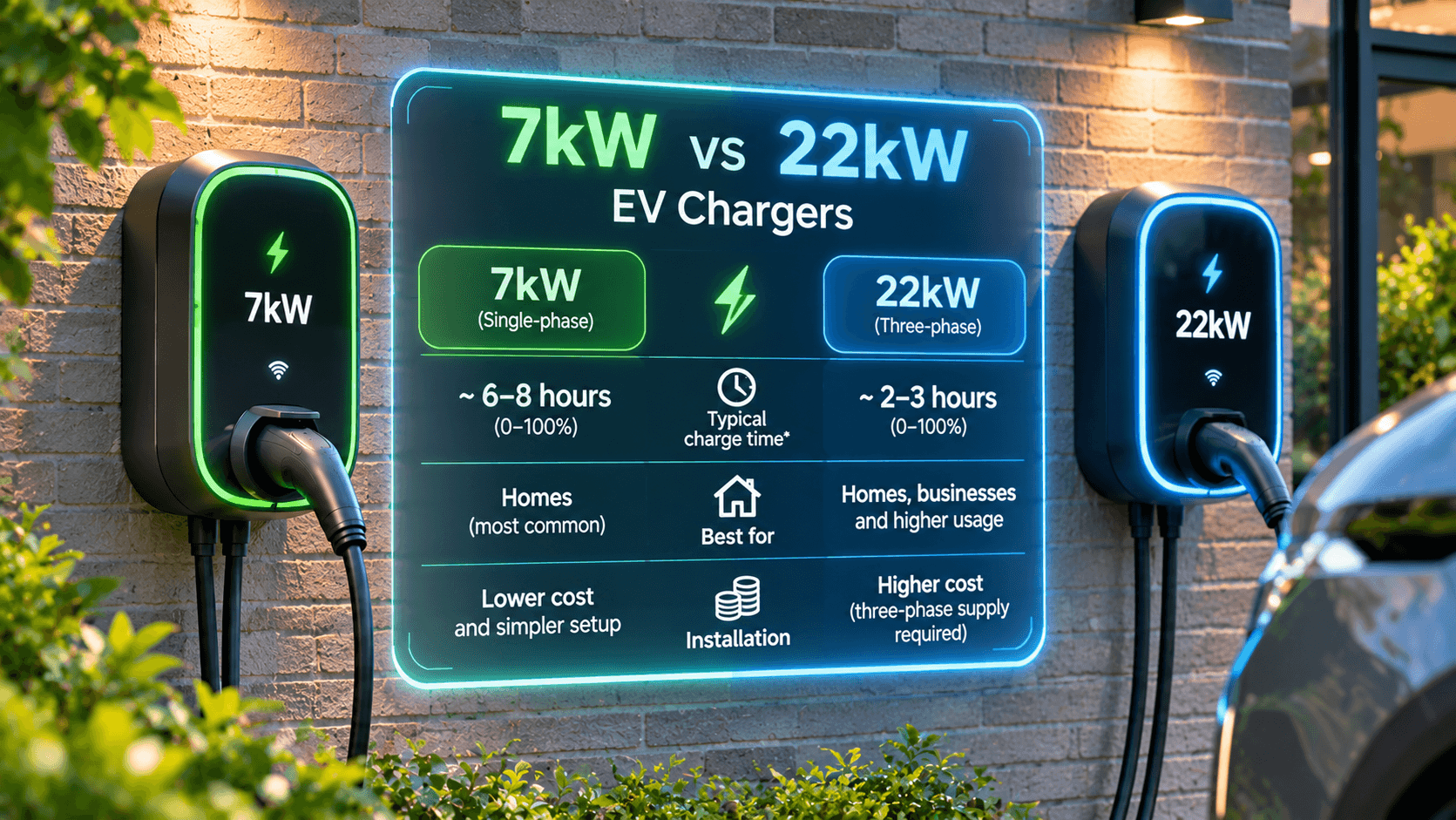
Is a 7kW Home Charger Fast Enough?
For many UK drivers, yes.
A 7kW charger can replenish a substantial amount of electricity during an overnight parking period.
For example, charging at 7kW for eight hours could deliver approximately 56kWh of electricity under ideal conditions.
The energy stored in the battery would be lower because of charging losses.
This is more than many drivers use during a typical day.
However, a driver who regularly covers very high mileage and has limited time at home may have different requirements.
A 22kW AC charger can provide faster charging where a suitable three-phase supply and compatible vehicle are available.
For more information, read our guide to 7kW vs 22kW EV chargers.
Is Home EV Charging More Convenient?
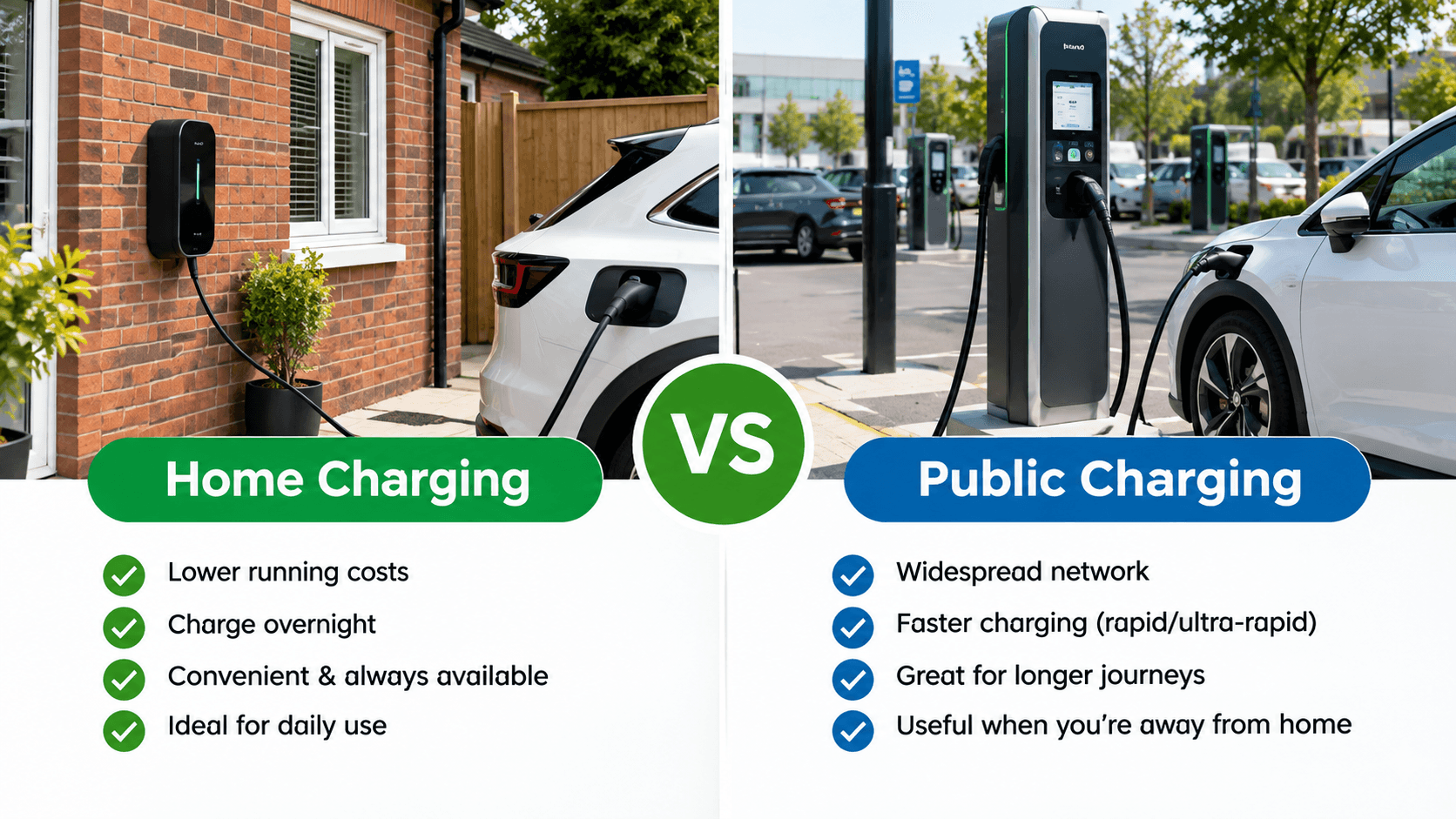
For drivers with a private driveway or dedicated parking space, home charging is often more convenient than public charging.
You can plug in your vehicle when you arrive home and disconnect it before leaving.
There is usually no need to make a separate journey to a charging station.
Advantages of Home Charging
- Charge while your vehicle is parked overnight.
- Avoid travelling to a public charging station.
- Use discounted electricity tariffs where available.
- Monitor charging through a compatible smart charger.
- Reduce dependence on public charger availability.
- Start many journeys with a replenished battery.
Disadvantages of Home Charging
- Requires suitable parking arrangements.
- Involves an upfront installation cost.
- Charging is usually slower than public DC rapid charging.
- May require electrical upgrades.
- Not every property is suitable for installation.
Home charging is particularly useful for drivers with predictable daily routines.
What Are the Advantages of Public EV Charging?
Public charging remains essential, even for drivers who have a home charger.
It provides flexibility when travelling beyond the vehicle's normal range and can support people who cannot install private charging equipment.
Advantages of Public Charging
Rapid charging on longer journeys
Public rapid and ultra-rapid chargers can provide substantial energy during a relatively short stop.
No private installation required
Drivers can use public charging without purchasing and installing a home charging point.
Useful for flats and terraced houses
Public charging can be particularly important for households without off-street parking.
Destination charging
Some hotels, shopping centres and leisure facilities allow drivers to charge while visiting.
Flexible charging locations
Public networks provide charging opportunities away from home.
Disadvantages of Public Charging
Public charging may involve:
- Higher electricity prices.
- Waiting for an available charger.
- Additional parking or idle fees.
- Differences between payment systems.
- Uncertainty about charger reliability.
- Detours from your normal journey.
The experience depends heavily on the location and charging network.
Can You Own an Electric Car Without a Home Charger?
Yes.
Many people own electric vehicles without having a private home charging point.
However, the convenience and cost of EV ownership can depend on the charging infrastructure available nearby.
If you live in a flat or terraced house without a driveway, you may need to rely on public on-street chargers, workplace charging or other facilities.
Some local authorities also support approved cross-pavement charging solutions that allow certain households to use a home charger with on-street parking.
However, permissions and availability vary.
For a detailed explanation, read our guide to installing an EV charger without a driveway.
Can Solar Panels Make Home EV Charging Cheaper?
Potentially, yes.
If your home has solar panels, you may be able to use some of the electricity generated by your system to charge your electric vehicle.
A compatible smart charger can help manage surplus solar generation.
However, solar electricity is not automatically free in financial terms.
You need to consider equipment costs and any export payments you would otherwise receive.
For example, if you can export solar electricity for 15p per kWh but charge your vehicle overnight for 8p per kWh, exporting during the day and charging overnight may be financially preferable.
The best approach depends on your tariff and household energy arrangements.
Our guide to charging an electric car with solar panels explains how solar EV charging works and when it may be worthwhile.
Does the Type of Home EV Charger Affect Charging Costs?
The charger itself generally has less influence on electricity costs than the tariff and amount of energy consumed.
However, some smart charging features can help reduce costs.
For example, a charger with scheduling functionality may allow you to charge during cheaper overnight periods.
Some chargers also integrate with intelligent electricity tariffs.
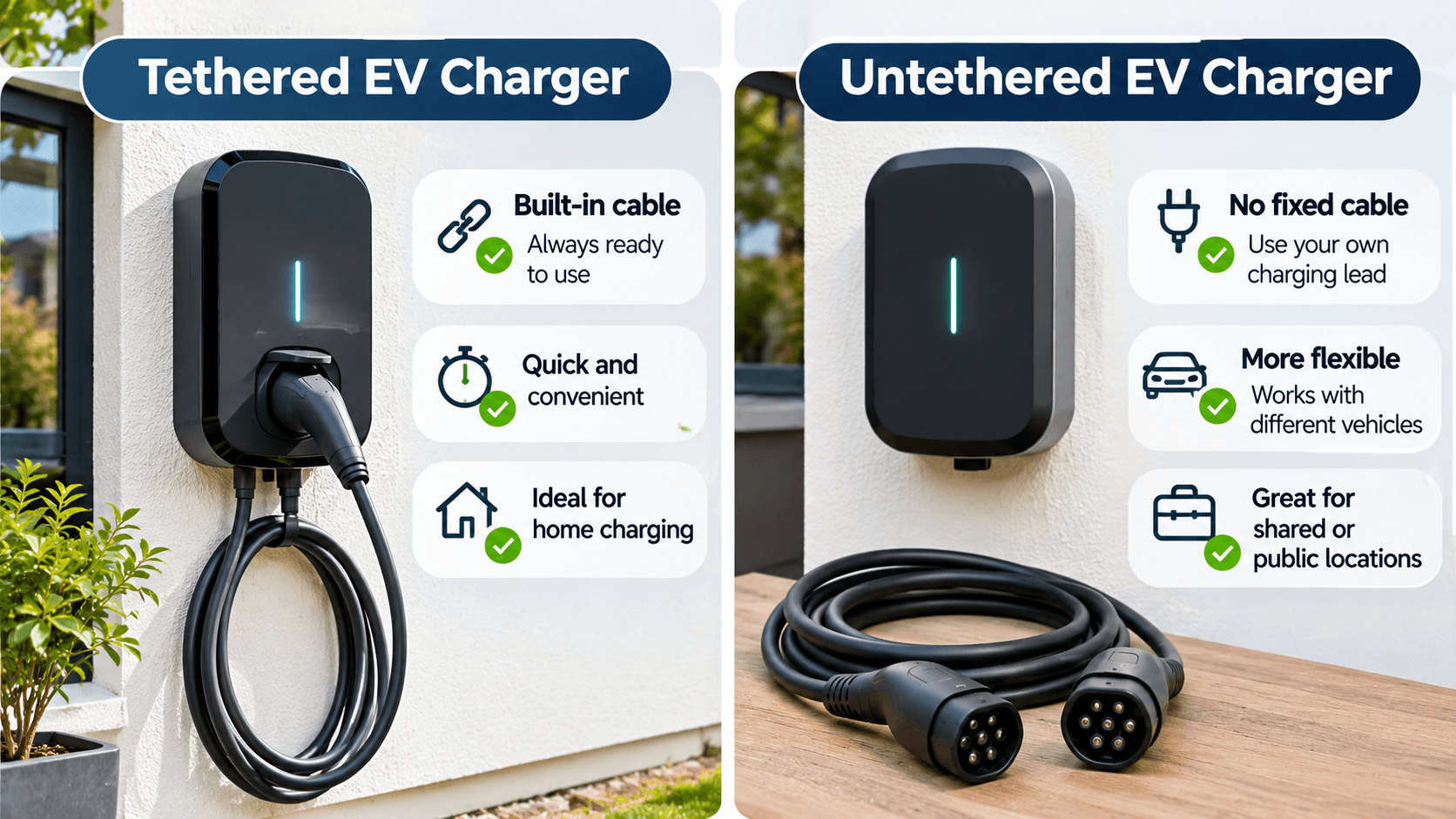
Tethered vs Untethered Chargers
A tethered charger has a permanently attached cable.
An untethered charger uses a separate detachable cable.
Neither option is inherently cheaper to operate.
The main differences relate to convenience, appearance and cable management.
Our guide to tethered vs untethered EV chargers explains the advantages of each option.
Choosing Smart Charging Features
Before purchasing a charger, check whether it supports:
- Scheduled charging.
- Your preferred electricity tariff.
- Energy consumption monitoring.
- Dynamic load management.
- Solar charging, if relevant.
- Reliable connectivity.
For a complete buying guide, see how to choose the best home EV charger in the UK.
Is Home Charging Better for Battery Health?
Home charging typically uses lower-power AC charging, while public rapid chargers deliver higher-power DC charging.
Modern electric vehicles have battery management systems designed to control charging power and protect the battery.
Frequent high-power charging can contribute to battery ageing under certain conditions, but the actual effect depends on the vehicle, battery chemistry, temperature and charging habits.
It would be misleading to claim that public rapid charging always damages EV batteries.
For everyday charging, following the vehicle manufacturer's recommendations is generally the best approach.
Some manufacturers recommend keeping the battery within a particular charge range for routine use, while others provide different guidance for specific battery chemistries.
Check your vehicle's manual for the appropriate charging recommendations.
Home vs Public Charging: Which Is Better for Different Drivers?
The best charging arrangement depends on how and where you drive.
Daily Commuters With a Driveway
Home charging is often the most convenient and economical choice.
You can charge overnight and avoid regular visits to public charging stations.
Drivers With High Annual Mileage
Home charging may offer substantial savings because more electricity is consumed throughout the year.
However, public rapid charging may still be necessary for longer journeys.
Drivers Living in Flats
Public on-street charging, workplace charging or communal charging facilities may be more practical.
If you have allocated private parking, a dedicated charger may be possible with the necessary permissions.
Drivers Who Rarely Use Their Cars
If your annual mileage is very low, the financial savings from installing a home charger may take longer to recover the upfront cost.
Access to affordable nearby public charging could be sufficient.
Drivers Who Frequently Travel Long Distances
A combination of home charging and public rapid charging is often the most practical solution.
Home charging covers everyday journeys, while public charging provides flexibility when travelling.
How to Decide Whether to Install a Home EV Charger
If you're considering home charging, start by assessing your driving habits and property.
Step 1: Estimate Your Annual Mileage
Higher annual mileage generally means greater electricity consumption and potentially larger savings from lower charging rates.
Step 2: Check Your Parking Arrangements
Determine whether you have suitable private off-street parking.
If not, investigate local charging options and any approved cross-pavement solutions.
Step 3: Compare Electricity Prices
Check your household electricity tariff and compare it with the public charging prices you would otherwise pay.
Remember to consider the entire household electricity bill when evaluating an EV tariff.
Step 4: Estimate Your Annual Charging Costs
Calculate your expected electricity consumption and compare different charging methods.
Use realistic prices based on the charging options available to you.
Step 5: Obtain Installation Quotes
Ask installers to assess your property's electrical supply and provide a quotation for the necessary equipment and work.
Step 6: Calculate Potential Savings
Compare the upfront installation cost with the estimated annual savings.
Remember that future electricity prices and driving habits may change.
Step 7: Choose a Suitable Charger
Consider charging power, smart features, cable configuration and warranty support.
Our home EV charger installation process guide explains what happens after you decide to proceed.
Frequently Asked Questions
Is It Cheaper to Charge an Electric Car at Home or at a Public Charger?
Home charging is generally cheaper, particularly when using a discounted overnight EV electricity tariff. However, prices vary, and some public or workplace charging options may be competitively priced.
How Much Does It Cost to Charge an EV at Home in the UK?
The cost depends on your electricity tariff and the amount of electricity purchased. For example, 50kWh costs £4 at 8p per kWh or £13 at 26p per kWh, excluding other tariff charges.
Is Public EV Charging Expensive?
Public charging can be more expensive than home charging, particularly at rapid and ultra-rapid charging stations. However, prices vary between networks, locations and charging speeds.
Is a Home EV Charger Worth the Installation Cost?
For many drivers with private parking, yes. Lower electricity prices and greater convenience can make home charging worthwhile. However, the financial return depends on annual mileage, installation costs and alternative charging prices.
Can I Charge an Electric Car Without a Driveway?
Yes. Public charging, workplace charging and approved cross-pavement charging solutions may provide options. Availability and permissions depend on your location.
Is Home EV Charging Slower Than Public Charging?
Home charging is generally slower than public DC rapid charging. However, some public AC chargers operate at similar speeds to domestic charging points.
Can I Charge My EV Overnight at Home?
Yes. Overnight charging is one of the main advantages of a dedicated home charging point. A compatible smart charger can also schedule charging during discounted electricity periods.
Do I Need a 22kW Home Charger?
Usually not for a typical UK household. A 7kW charger is often sufficient for overnight charging. A 22kW charger generally requires a suitable three-phase supply and compatible vehicle.
Is It Cheaper to Charge With Solar Panels?
It can be. However, the financial benefit depends on solar generation, electricity import prices, export payments and equipment costs.
Can I Use Both Home and Public EV Chargers?
Yes. Many EV drivers use home charging for everyday journeys and public charging when travelling longer distances.
Compare Home EV Charger Installation Quotes
Home EV charging can provide a convenient and potentially economical way to keep your electric vehicle ready for everyday use.
For drivers with suitable private parking, a home charger combined with a competitive electricity tariff may offer substantial savings compared with relying on public rapid charging.
However, the financial benefits depend on your mileage, electricity prices and installation requirements.
Before choosing a charging point, it is worth comparing installation quotes and understanding the electrical requirements of your property.
PickASparky helps you find eligible EV charger installers covering your area, allowing you to compare installation options and request quotes.