Usage and cost
How Much Does EV Charger Installation Cost in the UK? (2026 Guide)
Installing a home EV charger is one of the most convenient ways to charge an electric car, but how much should you expect to pay for the equipment and installation? In the UK, a typical home EV charger installation costs approximately **£800 to £1,200**, including the charger and standard installat
By PickASparky Team
12 min read
Installing a home EV charger is one of the most convenient ways to charge an electric car, but how much should you expect to pay for the equipment and installation?
In the UK, a typical home EV charger installation costs approximately £800 to £1,200, including the charger and standard installation. However, the final price can vary considerably depending on your property, electrical supply, charger model and the amount of work required.
In this guide, we explain what you get for your money, which installation factors can increase the price, whether government grants can help, and how to avoid unnecessary costs.
How Much Does a Home EV Charger Cost to Install?
According to the Energy Saving Trust (opens in a new tab), a typical home chargepoint installation costs around £800 to £1,200.
This is a useful starting point for budgeting, but it is not a fixed price. Some straightforward installations may cost less, while properties requiring additional electrical work, extensive cabling or groundworks can cost substantially more.
Typical EV Charger Installation Costs
| Installation Type | Indicative Total Cost | What's Involved |
|---|---|---|
| Straightforward installation | £800–£1,200 | Home charger fitted close to a suitable electrical supply, with relatively simple cabling |
| Installation with additional cabling | £1,000–£1,500 | Longer cable runs, more labour or additional cable protection |
| More complex installation | £1,500–£2,500+ | Groundworks, electrical upgrades or difficult cable routes |
| Charger replacement | Quote required | Replacing an existing charger, potentially reusing suitable infrastructure |
These are illustrative budgeting ranges, not guaranteed installer prices or verified national averages for each installation category. Actual quotes may fall outside these ranges.
The most reliable way to establish the cost is to obtain quotes based on your property's electrical requirements.
What Is Included in a Standard EV Charger Installation?
Many suppliers advertise an installed price for a home EV charger, but the definition of a standard installation can differ between providers.
A typical package may include:
- The EV charging unit.
- Mounting the charger on a suitable wall or other approved surface.
- A specified length of electrical cabling.
- Suitable electrical protection and associated installation materials.
- Connection to the property's electrical supply.
- Testing, commissioning and demonstration of the charger.
- Required electrical certification and network notification or approval arrangements.
Some installers also include initial smart charger configuration, such as connecting the unit to Wi-Fi and setting up the manufacturer's app.
Before accepting a quote, check exactly what is included. A low advertised price may not cover additional cable lengths, groundworks or electrical upgrades.
What Factors Affect EV Charger Installation Costs?
Two homeowners purchasing the same EV charger can receive very different installation quotes.
The main reason is that every property has different electrical and physical requirements.
1. Distance Between the Consumer Unit and Charger
Cable distance is one of the most common factors affecting installation cost.
If your consumer unit is close to the proposed charger location, installation may be relatively straightforward.
However, a charger positioned on a detached garage or at the opposite end of a property may require a longer cable route, additional protection and more labour.
Installers also need to consider how cables will pass through walls, around buildings or beneath surfaces.
2. Electrical Supply and Consumer Unit Condition
Before installing an EV charger, an electrician must assess whether the existing electrical installation is suitable.
Some properties may require:
- Additional circuit protection.
- Changes to the consumer unit.
- Earthing or protective measures.
- Load management equipment.
- Electrical supply upgrades or approval from the electricity network operator.
Not every property requires these changes. A competent installer should explain which work is necessary and why.
3. Charger Brand and Features
Home EV chargers vary in price depending on their design, connectivity and functionality.
Features that may affect equipment cost include smart charging schedules, solar integration, dynamic load balancing, built-in cables and manufacturer-specific software.
A premium charger is not necessarily the best choice for every household. The most suitable model depends on your vehicle, electricity tariff, property and charging habits.
4. Groundworks and Underground Cabling
If the charger cannot be mounted directly on the house, underground cabling may be necessary.
For example, an installation at a detached garage could require a cable route beneath a driveway or garden.
Excavation, protective ducting, reinstating paving and other groundworks can significantly increase the total price.
Where possible, discuss alternative cable routes with the installer before agreeing to expensive excavation work.
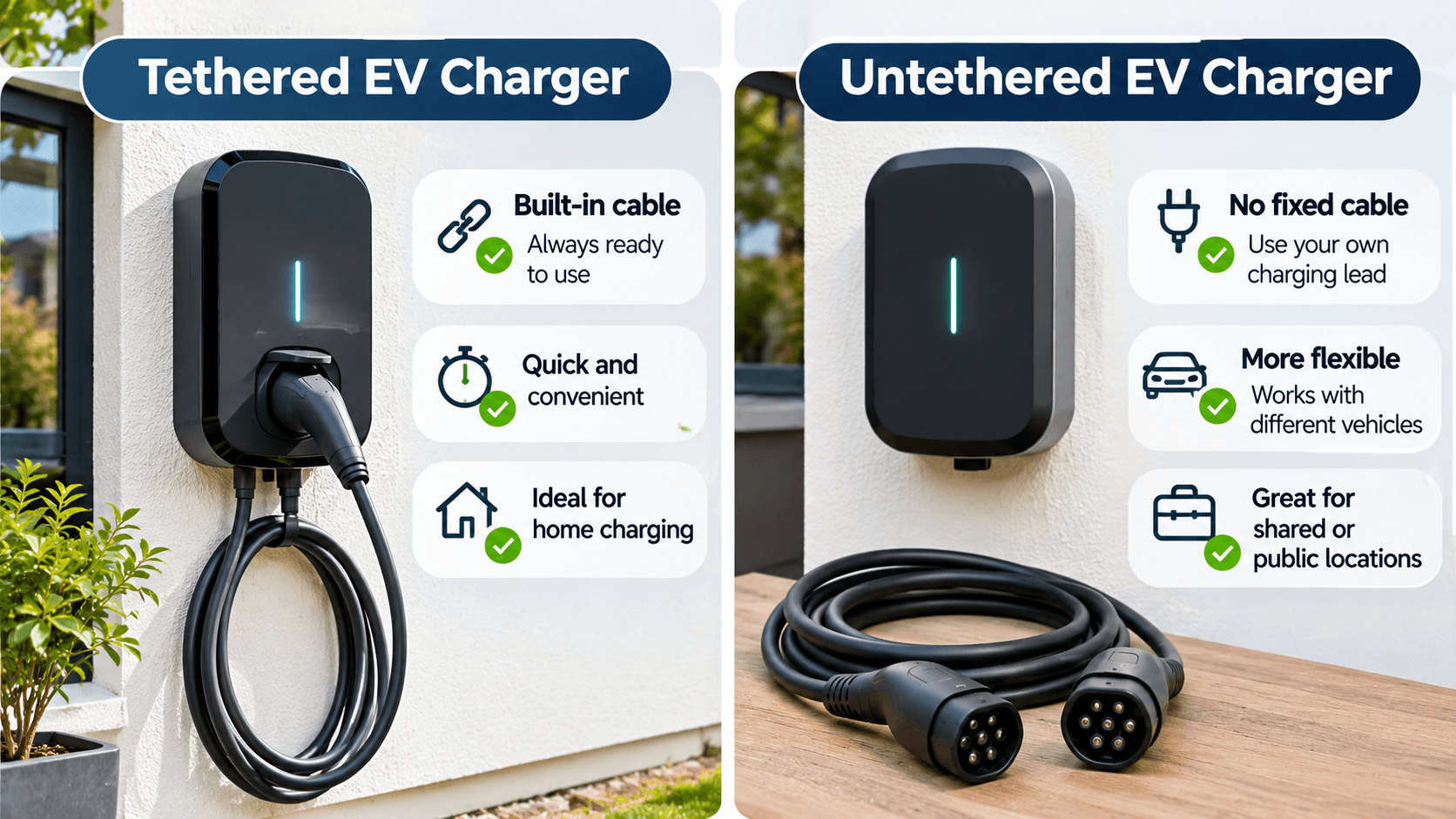
5. Tethered or Untethered Charger
A tethered charger has a permanently attached charging cable, while an untethered unit requires you to connect a separate compatible cable.
Tethered chargers can be more convenient for everyday use, while untethered models offer a tidier appearance when not in use.
The equipment price may differ, although the choice does not necessarily make a major difference to installation labour.
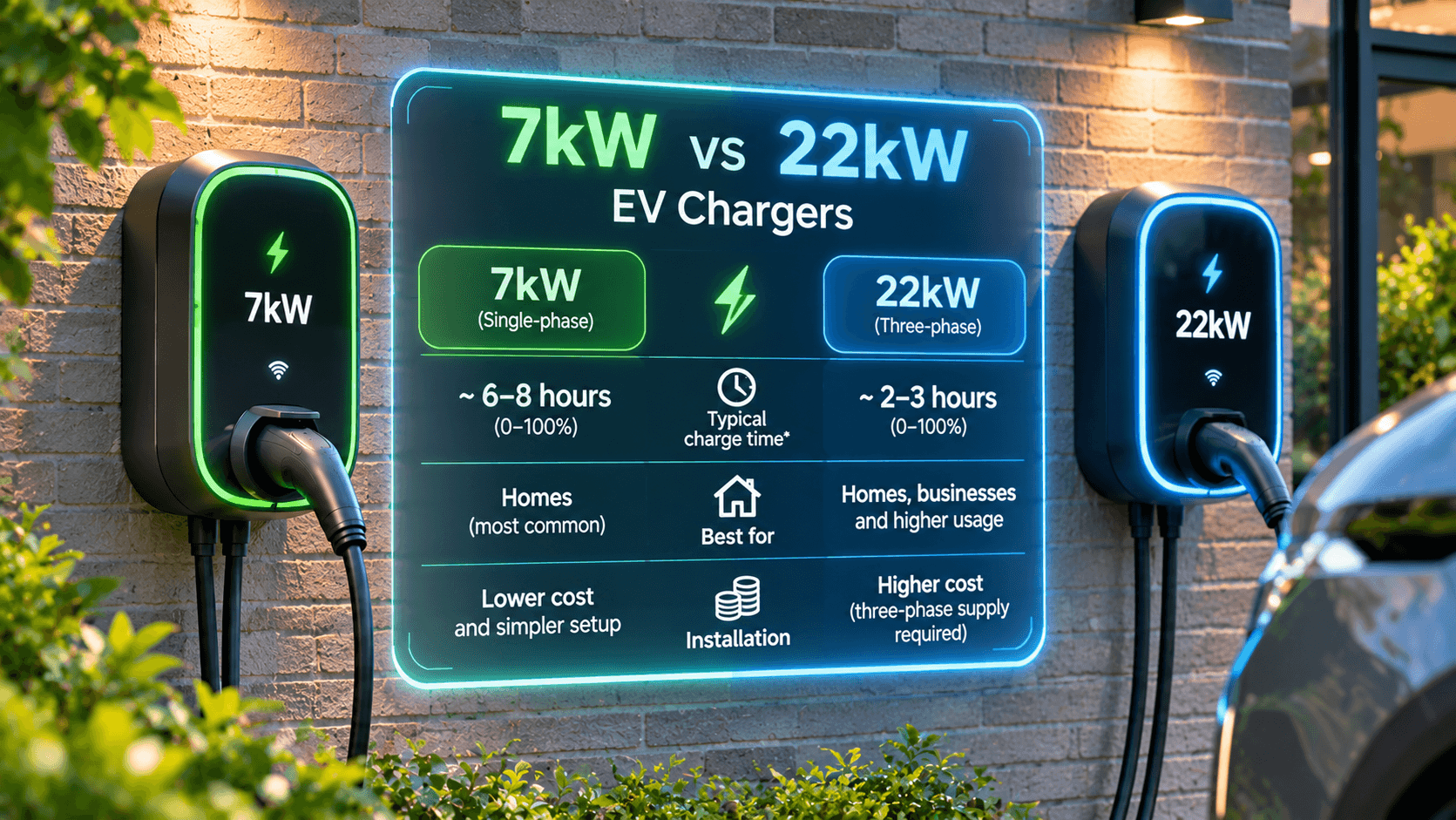
6. Charger Power and Electrical Supply
Most UK homes have a single-phase electricity supply, making a charger rated at approximately 7kW a common domestic choice.
A 22kW charger generally requires a suitable three-phase supply and a vehicle capable of accepting that charging power.
Installing a higher-rated charger will not automatically make charging faster if the property's supply or the vehicle's onboard charger limits the available power.
Is a 7kW Home EV Charger Worth the Cost?
For many households, a 7kW home charger provides a practical balance between charging speed, equipment cost and compatibility with domestic electrical supplies.
For example, a charger delivering approximately 7kW could theoretically supply 42kWh of electricity over six hours.
Actual energy added to the battery will be lower because of charging losses, and charging power may vary during the session.
For drivers who park at home overnight, this can provide a substantial amount of charging without needing a more powerful installation.
A 22kW charger may be appropriate for certain properties with three-phase electricity, but the additional installation requirements should be considered carefully.
Are There Government Grants for Home EV Charger Installation in 2026?
Yes. Some households can receive financial assistance through UK government EV chargepoint grant schemes.
From 1 April 2026, eligible applicants under certain schemes can receive up to £500 towards chargepoint purchase and installation costs, subject to scheme conditions.
Grants for Renters and Flat Owners
The EV chargepoint grant for renters and flat owners can cover up to 75% of eligible purchase and installation costs, capped at £500.
Applicants generally need to own and live in a flat or rent an eligible residential property, have qualifying private off-street parking and meet the other scheme requirements.
Homeowners living in an ordinary house they own are generally not eligible for this particular grant.
Grants for Households With On-Street Parking
A separate scheme can provide up to £500 towards an eligible chargepoint installation for households with on-street parking that are installing a qualifying cross-pavement charging solution.
Additional permissions and eligibility conditions apply, particularly where public pavements are involved.
How Much Could a Grant Save?
Consider an illustrative installation quote of £1,000.
If the full installation cost qualifies and the applicant meets the grant conditions, a £500 contribution could reduce the amount paid by the homeowner to £500.
This is only an example. Actual support depends on the grant scheme, eligible costs and approval.
For current eligibility requirements, visit the UK government's EV chargepoint grants guidance (opens in a new tab).
How Much Does It Cost to Run a Home EV Charger?
The installation price is only one part of the overall cost of home EV charging.
Once your charger is installed, your running costs depend primarily on the electricity tariff, energy consumed and charging efficiency.
For example, suppose you need to purchase 50kWh of electricity from the grid for a charging session.
| Electricity Rate | Cost of 50kWh |
|---|---|
| 8p per kWh | £4.00 |
| 15p per kWh | £7.50 |
| 26p per kWh | £13.00 |
| 30p per kWh | £15.00 |
These rates are illustrative, not current tariff quotations. The example measures electricity purchased from the grid, including energy lost during charging.
Drivers with access to a suitable off-peak electricity tariff may be able to reduce their charging expenses by scheduling charging during cheaper hours.
For a detailed breakdown of charging prices, battery sizes and electricity costs, read our guide to how much it costs to charge an electric car at home.
Is It Cheaper to Buy an EV Charger Separately?
Some installers supply both the charger and installation as a complete package, while others allow customers to purchase their own charging equipment.
Buying a charger separately can sometimes be worthwhile, particularly if you find a competitively priced model.
However, compare the complete cost rather than the equipment price alone.
Before purchasing independently, confirm that your chosen installer is willing to fit the model and that it is compatible with your electrical installation.
You should also establish who is responsible for equipment warranties, installation workmanship and any manufacturer support requirements.
A combined supply-and-installation package may offer greater convenience, but it is worth comparing both approaches.
How Can You Reduce EV Charger Installation Costs?
Reducing installation costs does not mean compromising electrical safety.
There are several practical ways to avoid unnecessary expenses.
Compare More Than One Installation Quote
Different installers may recommend different cable routes, charger models or installation methods.
Obtaining comparable quotes can help you identify the most suitable solution and understand whether additional work is genuinely required.
Choose a Practical Charger Location
Where possible, installing the charger near a suitable electrical supply can reduce cabling and labour costs.
However, the final location must also be safe, convenient and suitable for the vehicle's parking position.
Avoid Paying for Features You Won't Use
Not every household needs advanced solar integration, premium connectivity features or a three-phase charger.
Choose equipment that matches your actual charging requirements rather than simply selecting the most expensive model.
Check Grant Eligibility Before Booking
If you are a renter, flat owner or household with on-street parking, check whether financial support is available before arranging installation.
Some grant schemes require an approved application and an authorised installer, so completing the work before following the correct process could affect eligibility.
Ask for an Itemised Quote
A clear quotation should distinguish the charger, installation labour and any additional electrical work or groundworks.
It should also explain which costs are fixed and which could change following an on-site inspection.
How Long Does EV Charger Installation Take?
A straightforward home EV charger installation can often be completed within one working day.
However, the time required depends on the cable route, electrical condition, access and any additional work.
More complex projects involving groundworks, supply upgrades or network approval may take longer and require multiple visits.
Your installer should explain the expected timescale before work begins.
Do You Need a Qualified Electrician to Install an EV Charger?
A dedicated EV chargepoint is a substantial electrical load and must be installed safely in accordance with applicable electrical requirements.
A suitably competent electrician with relevant EV chargepoint installation experience should assess the property, install appropriate protection, test the equipment and provide the required documentation.
Depending on the installation, the electricity distribution network operator may need to approve the connection in advance or receive notification after installation.
If you are applying for a government chargepoint grant, the installer must also meet the relevant scheme's authorisation requirements.
Frequently Asked Questions
Can I Install an EV Charger Myself?
A dedicated home EV charger should be installed by a suitably competent professional who can meet the applicable electrical safety, testing and certification requirements. It is not a typical DIY project.
Does a 7kW Charger Cost More to Install Than a 3.6kW Charger?
Not necessarily. The final cost depends on the equipment and electrical installation requirements. A higher-powered charger may require different cabling or protection, but the property's existing electrical infrastructure is often a more significant factor.
Will I Need a New Consumer Unit?
Not always. An installer will assess the existing consumer unit, electrical protection and available capacity. Some installations can proceed without replacing the consumer unit, while others may require additional equipment or upgrades.
Can I Install an EV Charger in a Detached Garage?
Yes, provided the electrical supply and installation arrangements are suitable. Additional cabling, groundworks or electrical protection may increase the cost.
Is It Cheaper to Install an EV Charger When Buying a New Electric Car?
Sometimes. Vehicle manufacturers, dealerships and charging providers may offer installation packages or promotions. Compare the total package price and the equipment supplied against independent installation quotes.
Do I Need Planning Permission for a Home EV Charger?
Many domestic chargepoint installations can qualify as permitted development, subject to relevant conditions. Listed buildings, protected locations, public footways and certain installation arrangements may require additional permissions.
How Much Does It Cost to Replace an Existing EV Charger?
Replacement costs depend on the condition and suitability of the existing cabling, protection and mounting arrangements. If infrastructure can safely be reused, replacement may be simpler than a completely new installation. An electrician should assess this before quoting.
Compare Home EV Charger Installation Quotes
The cost of installing an EV charger depends on more than the charger itself. Electrical capacity, cable distance, property layout and additional installation work all influence the final price.
Rather than relying on an advertised standard installation price, it is worth comparing quotes that reflect your property's requirements.
PickASparky helps you find eligible EV charger installers covering your area, so you can explore installation options and compare responses.