Planning permissions
Do You Need Planning Permission for an EV Charger in the UK? (2026 Guide)
Installing a home EV charger is one of the most convenient ways to charge an electric car. But before arranging installation, many homeowners have an important question: do you need planning permission for an EV charger? The answer depends on where you live, the type of property you own and where t
By PickASparky Team
20 min read
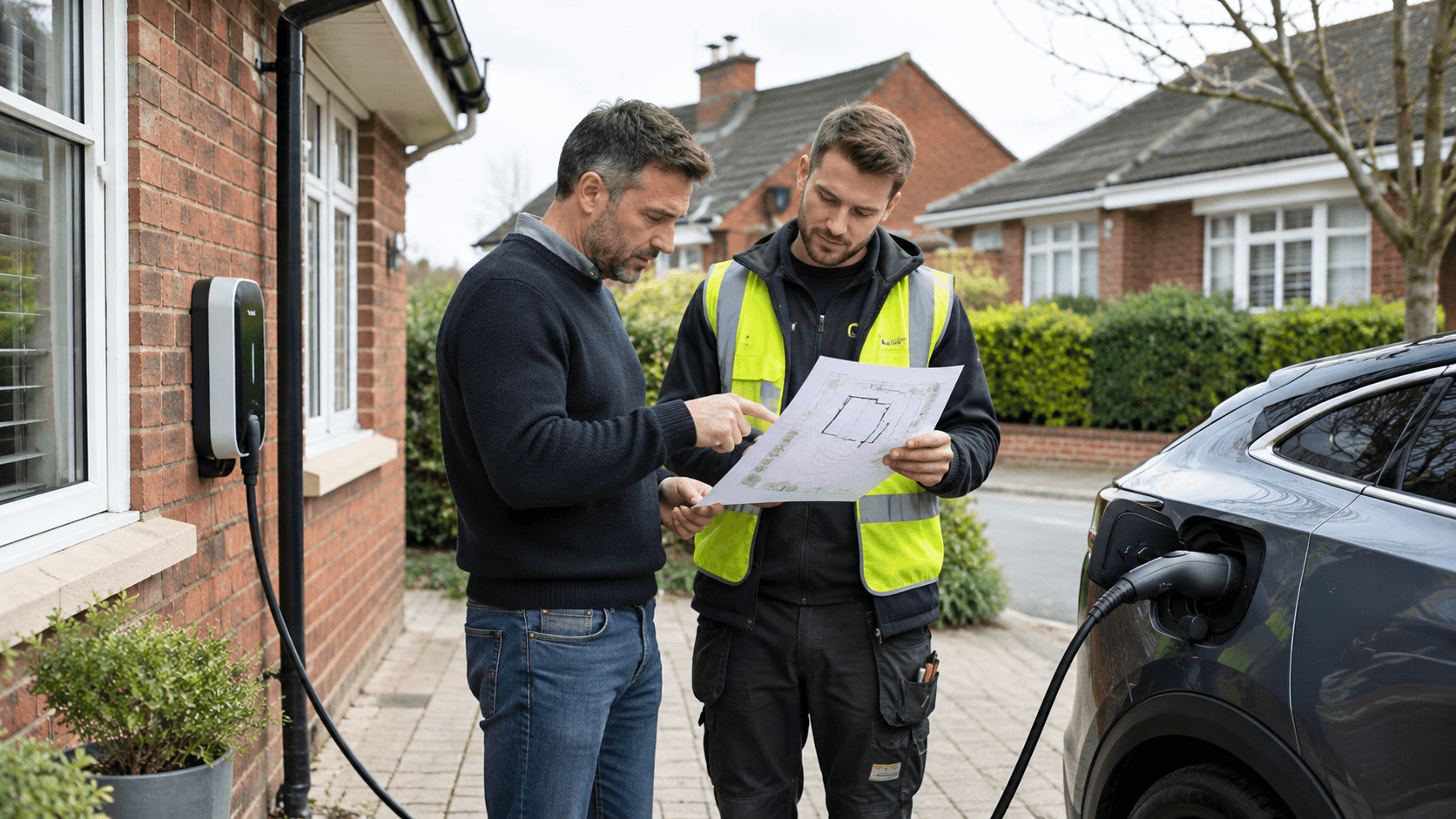
Installing a home EV charger is one of the most convenient ways to charge an electric car. But before arranging installation, many homeowners have an important question: do you need planning permission for an EV charger?
The answer depends on where you live, the type of property you own and where the charging equipment will be installed.
In England, many domestic EV charger installations do not require a separate planning application because they qualify as permitted development. However, certain conditions must be met, and additional permissions may still be necessary.
For example, installing a charger beside your private driveway is generally more straightforward than fitting one to a listed building or arranging a charging cable across a public pavement.
The rules also differ between England, Scotland, Wales and Northern Ireland.
In this guide, we explain the UK planning permission rules for home EV chargers, including permitted development rights, listed buildings, conservation areas, flats, rented properties and on-street charging.
Do You Need Planning Permission to Install a Home EV Charger?
In many cases, no.
In England, domestic EV charging equipment can often be installed under permitted development rights, meaning you do not need to submit a full planning application.
However, the installation must satisfy the relevant conditions.
Factors that can affect whether planning permission is required include:
- Whether the charger is wall-mounted or installed on a post.
- The size and position of the charging equipment.
- Whether the property is listed.
- Whether the installation is within a protected area.
- Whether permitted development rights have been restricted.
- Whether the charger serves private parking or on-street parking.
- Whether the charging cable needs to cross a public pavement.
Importantly, planning permission is not the only approval you may need.
Electrical safety requirements, landlord consent, freeholder permission and highways approval are separate considerations.
EV Charger Planning Permission: Quick Comparison
The following table summarises common situations.
| Property or Installation | Is Planning Permission Usually Required? | Other Considerations |
|---|---|---|
| House with private driveway | Often not in England | Permitted development conditions |
| Wall-mounted charger on a garage | Often not in England | Location and property restrictions |
| Charger on a freestanding post | Often not in England | Height, position and other limits |
| Listed building | Additional approval likely | Listed building consent |
| Property in a conservation area | Depends on installation | Local restrictions and protected features |
| Rented house | Depends on planning circumstances | Landlord permission |
| Flat with allocated parking | May qualify for permitted development | Freeholder and management consent |
| Terraced house with on-street parking | May qualify under newer English rules | Authorised pavement crossing |
| Charger crossing a public pavement | Eligible installations may be permitted development in England | Highways authority authorisation |
This table provides general guidance. Planning rules vary across the UK, and individual properties may be subject to additional restrictions.
What Are Permitted Development Rights?
Permitted development rights allow certain building works and changes to be carried out without submitting a separate planning application.
These rights are established through planning legislation and are subject to specific limitations and conditions.
In England, EV charging equipment is covered by provisions within the Town and Country Planning (General Permitted Development) (England) Order 2015, as amended.
The rules include provisions for wall-mounted charging points, freestanding charging posts and certain cross-pavement charging solutions.
Why Do Permitted Development Rights Matter?
Without permitted development rights, homeowners might need to submit a planning application for relatively straightforward installations.
This could increase costs and delay installation.
Where the relevant conditions are met, permitted development rights simplify the process.
However, permitted development does not mean that every installation is automatically approved.
The equipment must still comply with the applicable limitations, and other legal requirements remain in place.
For further information, see the Planning Portal's guidance on permitted development for EV chargers (opens in a new tab).
Planning Permission for Wall-Mounted EV Chargers
Wall-mounted chargers are among the most common domestic installations.
They are typically installed on an external house wall or garage close to a private parking space.
In England, wall-mounted EV charging points may qualify as permitted development if they meet the relevant conditions.
What Are the Main Restrictions?
Under the applicable English permitted development provisions, relevant restrictions include:
- The charging outlet and casing must not exceed the permitted size limit.
- The installation must not be within a scheduled monument site.
- The installation must not be within the curtilage of a listed building.
- Any relevant conditions relating to highway access and cable routing must be satisfied.
For wall-mounted charging equipment, the permitted development rules include a maximum volume of 0.2 cubic metres for the outlet and casing.
Most conventional domestic wall-mounted chargers are considerably smaller than this, but the complete installation must still meet the relevant requirements.
Can You Install a Charger on the Front of Your House?
Potentially, yes.
A charger mounted on the front wall of a house may qualify as permitted development in England.
However, the location matters.
For example, where a charger immediately adjoins a highway, specific requirements may apply to the available pedestrian footway width.
You should also check whether your property has additional planning restrictions.
If the installation involves charging a vehicle parked across a public pavement, an authorised cross-pavement solution may be required.
Planning Permission for Freestanding EV Charging Posts
Not every property has a suitable wall beside its parking space.
Some homeowners prefer to install a charger on a freestanding post near the driveway.
These installations are sometimes called pedestal-mounted EV chargers.
In England, freestanding charging posts may also qualify as permitted development, subject to the applicable conditions.
What Restrictions Apply?
The rules include limitations relating to:
- The height of the charging post.
- Its position relative to highways.
- The number of posts serving parking spaces.
- Listed buildings and scheduled monuments.
- The location and use of the charging equipment.
The permitted height and positioning requirements depend on the particular installation.
Before purchasing a pedestal-mounted charger, ask your installer to check whether the proposed arrangement meets the relevant planning conditions.
Does a Charging Post Cost More to Install?
It can.
A wall-mounted charger can often be fixed directly to an existing suitable structure.
A freestanding charger may require:
- A mounting post.
- Suitable foundations.
- Underground electrical cabling.
- Groundworks.
- Additional cable protection.
These requirements can increase installation costs.
Our guide to EV charger installation costs in the UK explains the factors that affect the overall price.
Do You Need Planning Permission for an EV Charger in a Conservation Area?
Not necessarily, but additional checks are important.
Conservation areas are designated to protect places of special architectural or historic interest.
Being located within a conservation area does not automatically mean every EV charger installation requires planning permission.
However, the property's location, the type of equipment and any local restrictions can affect what is permitted.
What Is an Article 4 Direction?
An Article 4 direction is a planning control that can remove certain permitted development rights from a particular area or property.
Where relevant rights have been removed, work that would normally qualify as permitted development may require a planning application.
If your property is in a conservation area, check with the local planning authority before arranging installation.
How Can You Make an EV Charger Less Noticeable?
Where appearance is important, consider:
- A compact charging unit.
- A colour that complements the property.
- A discreet mounting position.
- Neatly routed electrical cabling.
- An untethered charger without a permanently visible cable.
However, a visually discreet installation must still meet electrical safety and accessibility requirements.
Our comparison of tethered vs untethered EV chargers explains the practical and visual differences.
Can You Install an EV Charger on a Listed Building?
Possibly, but additional restrictions apply.
Listed buildings are protected because of their special architectural or historic interest.
Installing electrical equipment on or near a listed building can affect protected features.
In England, the usual EV charger permitted development rights do not apply within the curtilage of a listed building under the relevant provisions.
You may therefore need planning permission.
Listed building consent may also be required where the work affects the building's character as a building of special architectural or historic interest.
What If the Charger Is Installed on a Separate Garage?
A separate garage does not automatically remove the planning restrictions.
If the garage is within the curtilage of a listed building, the relevant limitations may still apply.
The property's designation, layout and proposed work must be considered.
Who Should You Contact?
Before purchasing equipment, contact the local planning authority or conservation officer.
Explain:
- Where the charger would be installed.
- How it would be mounted.
- Where the electrical cable would run.
- Whether drilling or alterations to historic materials are required.
- Whether the installation would be visible from public areas.
Obtaining advice before installation can help avoid costly alterations later.
Do You Need Planning Permission for an EV Charger at a Flat?
Installing an EV charger at a flat can be more complicated than installing one at a detached or semi-detached house.
The planning position depends on the building, parking arrangements and proposed equipment.
In England, certain installations serving blocks of flats can qualify as permitted development.
However, planning permission is only one consideration.
Do You Need Freeholder Permission?
If you own a leasehold flat, you may need permission from the freeholder or building management company.
This can apply even if the installation does not require a planning application.
The lease may restrict alterations to:
- External walls.
- Shared electrical systems.
- Communal parking areas.
- Underground cabling.
- Shared access routes.
What If You Have an Allocated Parking Space?
An allocated parking space can make installation more practical, but it does not automatically give you permission to install electrical equipment.
You need to establish who owns or controls the parking area and whether electrical cables can legally be routed to it.
What About Communal EV Chargers?
Some residential developments may benefit from shared charging facilities rather than individual chargers.
These installations can involve additional electrical design, billing arrangements and management responsibilities.
For a block of flats, the best solution may require coordination between residents, the freeholder and a specialist installer.
Can You Install an EV Charger at a Rented Property?
Yes, potentially.
Renting a property does not automatically prevent you from having a home EV charger.
However, you will normally need the landlord's permission before making alterations.
What Should You Ask Your Landlord?
Before arranging installation, clarify:
- Whether the landlord agrees to the proposed charger.
- Who will pay for the equipment and installation.
- Who owns the charger after installation.
- Whether the charger can be removed when the tenancy ends.
- Who is responsible for maintenance and repairs.
- Whether any planning or building management approvals are required.
It is sensible to confirm these arrangements in writing.
Are There Grants for Renters?
Eligible renters may qualify for government support towards installing an EV charging point.
However, grant schemes have specific eligibility requirements and can change over time.
Check the latest government EV chargepoint grant guidance (opens in a new tab) before arranging installation.
Do You Need Planning Permission for an EV Charger Without a Driveway?
This is an important area where the rules in England changed during 2026.
On 21 October 2026, new permitted development provisions came into force for certain cross-pavement EV charging solutions.
These changes are intended to make home charging more accessible to households that park on the street.
Under the relevant conditions, eligible cross-pavement charging installations can proceed without a separate planning application.
However, highways authority permission is still required.
What Is a Cross-Pavement Charging Solution?
A cross-pavement charging solution provides an approved route for an EV charging cable to cross a public footway.
It may involve a recessed channel installed into the pavement.
The purpose is to allow the cable to reach a vehicle parked on the street while reducing obstruction and trip hazards.
What Changed in October 2026?
The English planning changes introduced permitted development rights for qualifying cross-pavement solutions and amended the rules for associated domestic charging equipment.
This means some homeowners who previously needed planning permission may no longer need to submit a separate planning application.
However, the installation must satisfy the applicable limitations and conditions.
For example, the new cross-pavement permitted development right does not apply to installations within designated conservation areas or scheduled monument sites, or within the curtilage of a listed building.
Other restrictions also apply.
Do You Still Need Council Permission?
Yes.
The highways authority must authorise the cross-pavement solution.
This is separate from planning permission.
The authority will need to consider pedestrian safety, accessibility, the highway's condition and other relevant matters.
You cannot simply cut a channel into the pavement yourself.
For a complete explanation of the options, read our guide to installing an EV charger without a driveway.
You can also consult the government's cross-pavement EV charging guidance (opens in a new tab).
Can You Run an EV Charging Cable Across a Public Pavement?
You should not assume that a charging cable can legally be placed across a public pavement.
A loose cable can create a trip hazard and obstruct pedestrians, particularly wheelchair users and people with visual impairments.
Using a rubber cable cover does not automatically make the arrangement lawful.
Some local authorities may have specific policies, restrictions or approved solutions.
In England, where an installation relies on the relevant permitted development provisions for charging across a footway, the cable must use an authorised cross-pavement solution.
Does a Pavement Charging Channel Give You a Parking Space?
No.
An approved pavement charging channel does not automatically reserve the parking space outside your home.
If the space is part of the public highway, other motorists may still be entitled to park there.
This is an important practical consideration before paying for an installation.
Planning Permission vs Highways Consent vs Electrical Certification
These requirements are often confused, but they serve different purposes.
| Requirement | What It Covers | Who Is Involved |
|---|---|---|
| Planning permission | Whether the proposed development is permitted | Local planning authority |
| Highways consent | Work affecting public roads or pavements | Highways authority |
| Landlord or freeholder consent | Permission to alter property or shared areas | Property owner or management |
| DNO notification or approval | Impact on the electricity distribution network | Distribution network operator |
| Electrical certification | Safety and compliance of electrical installation work | Competent electrical installer |
| Building Regulations compliance | Applicable building work requirements | Installer, competent person scheme or building control |
A project may require more than one of these approvals.
For example, a charger might qualify as permitted development but still require landlord permission and DNO notification.
Similarly, a cross-pavement installation may not require a separate planning application but will still need the relevant highways authorisation.
Do You Need DNO Approval to Install an EV Charger?
Possibly.
The distribution network operator, or DNO, manages the local electricity network supplying your property.
An EV charger adds electrical demand, so the network operator may need to be notified or consulted.
Depending on the existing supply and proposed installation, the electrician may be able to connect the charger and notify the DNO afterwards.
Other installations require an application and approval before connection.
Who Handles the DNO Application?
The EV charger installer normally manages the relevant technical notification or application.
However, confirm that this service is included in your quotation.
DNO requirements are separate from planning permission.
Our home EV charger installation process guide explains the electrical assessment, network checks, installation and certification stages.
Are the EV Charger Planning Rules the Same Across the UK?
No.
Planning legislation and permitted development rights differ between England, Scotland, Wales and Northern Ireland.
The October 2026 changes discussed above apply to England.
Homeowners elsewhere in the UK should check the rules for their own jurisdiction.
England
Many domestic installations can qualify as permitted development under the relevant English planning legislation.
The rules include provisions for wall-mounted chargers, freestanding posts and qualifying cross-pavement solutions.
Scotland
Scotland has its own planning legislation and permitted development framework.
The requirements depend on the proposed charging equipment, its location and any applicable restrictions.
Check with the relevant Scottish planning authority before installation.
Wales
Wales has its own permitted development provisions and planning requirements.
Do not assume that changes introduced in England automatically apply in Wales.
Contact the local planning authority if you are unsure whether the proposed installation requires permission.
Northern Ireland
Northern Ireland operates under a separate planning system.
Domestic EV charging installations should be assessed against the applicable Northern Ireland planning rules.
If the installation is unusual or affects a protected property, seek confirmation from the relevant planning authority.
How Much Does Planning Permission for an EV Charger Cost?
If your installation qualifies as permitted development, you generally do not need to pay a planning application fee.
However, other costs may still arise.
These can include:
- A planning application fee where permission is required.
- Fees for a lawful development certificate.
- Highways consent or licensing charges.
- Professional drawings or supporting information.
- Additional surveys.
- Changes to the proposed installation.
- Groundworks or pavement channel installation.
Fees depend on the type of application and the relevant authority.
Check the current charges before applying.
Does Planning Permission Affect the Installation Price?
It can.
Planning requirements may influence where the charger can be positioned and how electrical cables are routed.
For example, moving a charger to a less visible location may require a longer cable run.
Additional groundworks or mounting arrangements can increase costs.
For a breakdown of the main expenses, see our guide to EV charger installation costs in the UK.
What Is a Lawful Development Certificate?
A lawful development certificate provides formal confirmation from the local planning authority that a proposed development is lawful under planning legislation.
For example, you may believe your EV charger installation qualifies as permitted development but want written confirmation before proceeding.
In that situation, you may be able to apply for a certificate of lawful proposed use or development.
Do You Need One for Every EV Charger?
No.
A lawful development certificate is not automatically required for every installation that qualifies as permitted development.
However, it can be useful where the planning position is uncertain.
It may also provide documentation for future property transactions.
A certificate does not replace other permissions, such as highways consent or landlord approval.
What Happens If You Install an EV Charger Without Required Permission?
Installing equipment without the necessary planning permission can create problems.
If the work is unauthorised, the local planning authority may investigate and consider enforcement action.
Depending on the circumstances, you may need to:
- Apply for retrospective planning permission.
- Alter the installation.
- Relocate the charger.
- Remove unauthorised equipment.
- Restore affected areas.
Retrospective permission is not guaranteed.
There may also be separate consequences if work affects a public highway or protected building without the necessary consent.
It is generally easier to confirm the requirements before installation than to resolve problems afterwards.
How to Check Whether Your EV Charger Needs Planning Permission
Before arranging installation, follow these steps.
Step 1: Identify Your Property Type
Establish whether you live in a house, flat, rented property or listed building.
Check whether the property is in a conservation area or subject to other planning restrictions.
Step 2: Choose a Proposed Charger Location
Consider where the charger would be mounted and how the cable would reach the vehicle.
The location can affect planning requirements and installation costs.
Step 3: Check the Relevant Planning Rules
Review the guidance for your part of the UK.
In England, start with the Planning Portal and your local planning authority.
Step 4: Check for Additional Restrictions
Ask whether permitted development rights have been restricted or removed.
If your property is listed or within a protected area, seek specific advice.
Step 5: Confirm Property Permissions
If you rent or live in a managed development, obtain any necessary landlord, freeholder or management company consent.
Step 6: Check Highways Requirements
If the cable would cross a public pavement, contact the highways authority before purchasing equipment.
Step 7: Request Installation Quotes
Once the planning and property arrangements are understood, obtain quotations from suitable installers.
Explain any restrictions or permissions that may affect the installation.
Step 8: Arrange Electrical Assessment and Installation
The installer should assess the electrical supply, determine any DNO requirements and carry out the installation safely.
Appropriate testing and certification should follow.
Frequently Asked Questions
Do I Need Planning Permission for a 7kW EV Charger?
Not necessarily. In England, many standard domestic 7kW charger installations qualify as permitted development. The power rating alone does not determine whether planning permission is required. The property's location and installation details are also important.
Can I Install an EV Charger on My Driveway Without Planning Permission?
Often, yes, in England, provided the installation meets the relevant permitted development conditions. Additional restrictions may apply to listed buildings, protected locations and certain other properties.
Do I Need Planning Permission for an EV Charger on a Garage?
A charger mounted on a suitable garage wall may qualify as permitted development. However, the rules depend on the property's status and the proposed installation.
Can I Install an EV Charger on the Front Wall of My House?
Potentially, yes. Wall-mounted chargers may qualify as permitted development in England, but relevant restrictions and conditions still apply. Additional requirements may arise where the charger is beside a public highway.
Do I Need Planning Permission for an EV Charger in a Conservation Area?
Not always. Some installations may qualify as permitted development, but local restrictions can apply. Check whether an Article 4 direction or other planning controls affect your property.
Can I Install an EV Charger on a Listed Building?
Additional permission is likely to be necessary. The usual English EV charger permitted development provisions exclude installations within the curtilage of listed buildings. Listed building consent may also be required depending on the work.
Do I Need My Landlord's Permission?
Normally, yes, if you rent the property and the installation involves alterations. Landlord permission is separate from planning permission.
Do I Need Planning Permission for an EV Charger at a Flat?
Not necessarily. Some installations serving blocks of flats can qualify as permitted development in England. However, freeholder or building management consent may still be required.
Can I Install an EV Charger Without a Driveway?
Possibly. In England, certain approved cross-pavement charging solutions can qualify as permitted development under rules introduced in October 2026. Highways authority authorisation remains necessary.
Does Planning Permission Include Electrical Approval?
No. Planning permission concerns the proposed development. Electrical safety, certification and DNO requirements are separate matters.
Can an Electrician Apply for Planning Permission for Me?
Some installers may help identify planning requirements or coordinate applications, but this varies. Confirm what is included in the installation service before accepting a quotation.
Find an EV Charger Installer for Your Property
For many UK homeowners, installing an EV charger is relatively straightforward.
However, planning permission is only one part of the process.
The property's location, parking arrangements, electrical supply and any additional permissions all need to be considered.
A suitably qualified EV charger installer can assess the electrical requirements of your property and help you understand the practical installation options.
If planning permission, landlord consent or highways approval is necessary, these requirements should be clarified before installation begins.
PickASparky helps you find eligible EV charger installers covering your area, allowing you to compare installation options and request quotes.