Ev charger installation process
Home EV Charger Installation Process: Step-by-Step UK Guide
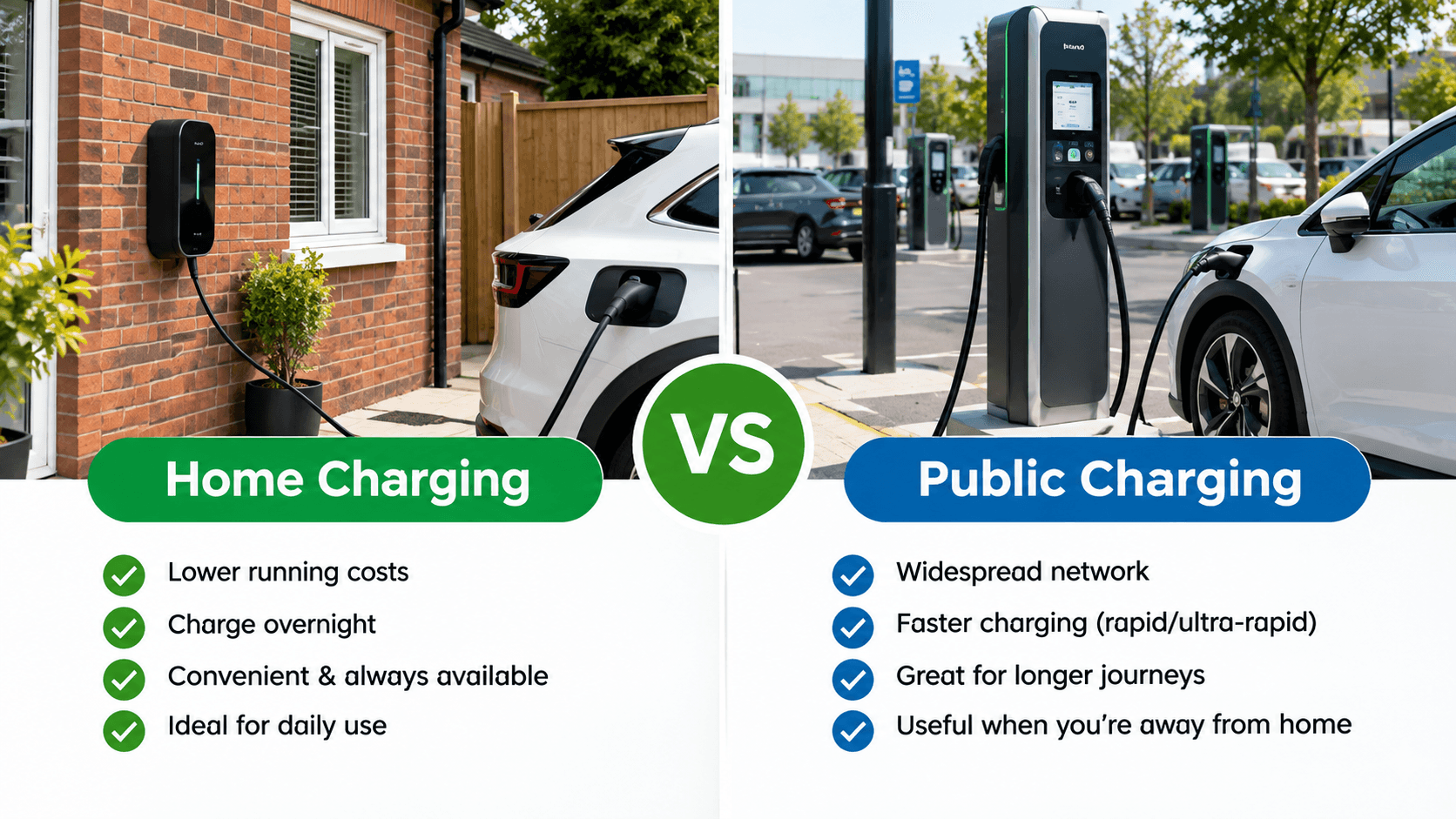
Installing a home EV charger is one of the most convenient ways to make electric vehicle ownership easier. Instead of relying on public charging stations, you can plug in your car at home and have it ready for your next journey. But what actually happens when you arrange a home EV charger installat
By PickASparky Team
21 min read
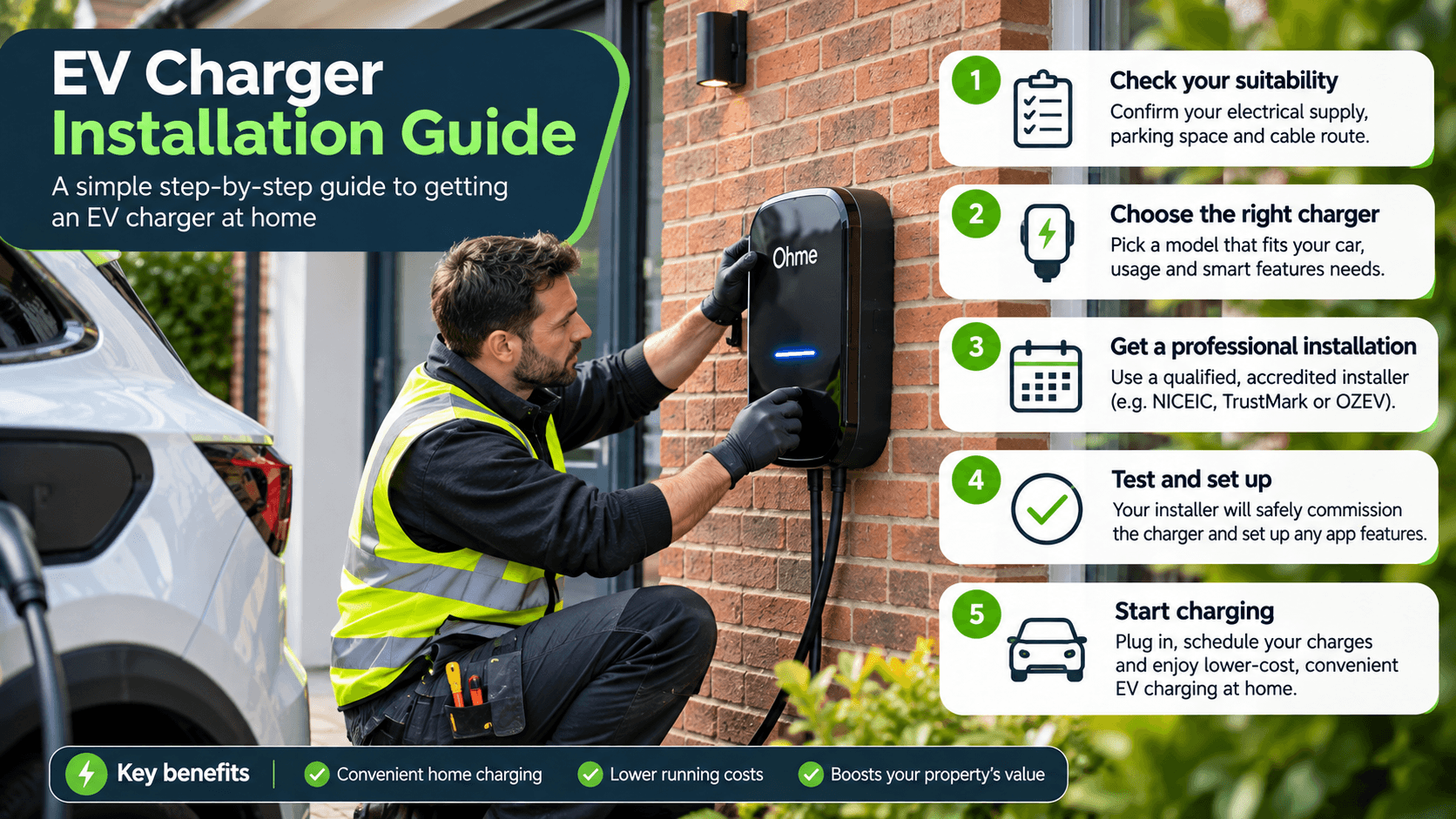
Installing a home EV charger is one of the most convenient ways to make electric vehicle ownership easier. Instead of relying on public charging stations, you can plug in your car at home and have it ready for your next journey.
But what actually happens when you arrange a home EV charger installation?
For many UK households, the process is relatively straightforward. A qualified installer assesses your property's electrical supply, recommends a suitable charging point, installs the equipment and carries out the necessary safety checks.
However, some properties require additional electrical work, permission from the electricity network operator or a more complicated cable route.
A straightforward home EV charger installation can often be completed within one working day, although the full process from requesting a quote to having a working charger may take longer.
In this guide, we explain each stage of the home EV charger installation process, including electrical surveys, DNO requirements, installation costs, testing and the documentation you should receive.
How Is a Home EV Charger Installed?
A typical home EV charger installation involves several stages, beginning with an assessment of your property and ending with testing and commissioning.
Home EV Charger Installation: Step-by-Step Overview
| Stage | What Happens | Typical Considerations |
|---|---|---|
| 1. Choose a charger | Select suitable charging equipment | Power, features and compatibility |
| 2. Request quotes | Provide property and installation details | Charger location, parking and cable distance |
| 3. Electrical assessment | Installer checks the existing electrical installation | Consumer unit, supply capacity and earthing |
| 4. Network checks | Installer determines DNO requirements | Notification, approval or supply upgrades |
| 5. Installation planning | Agree charger position and cable route | Access, groundworks and permissions |
| 6. Charger installation | Electrician installs the equipment | Mounting, cabling and electrical protection |
| 7. Testing | Electrical safety and operational checks | Protection, earthing and charger operation |
| 8. Commissioning | Configure and demonstrate the charger | Wi-Fi, app, scheduling and documentation |
Not every installation requires extensive preparation.
For example, a modern property with suitable electrical capacity and a driveway close to the consumer unit may need relatively little additional work.
However, a detached garage, older electrical installation or property without off-street parking may require more planning.
Step 1: Choose the Right Home EV Charger
Before arranging installation, consider which charging point is most suitable for your vehicle and property.
Home EV chargers differ in power, cable configuration, connectivity and additional features.
For many UK households, a 7kW smart charger is a practical option.
Most UK homes use single-phase electricity, and a charger rated at approximately 7kW can provide substantial overnight charging.
A 22kW charger generally requires a suitable three-phase electricity supply and a vehicle capable of accepting that charging power.
Installing a more powerful charger does not necessarily mean your vehicle will charge faster.
Our guide to 7kW vs 22kW EV chargers explains the differences in charging speeds, electrical requirements and installation costs.
Tethered or Untethered Charger?
You will also need to decide whether you prefer a tethered or untethered charging point.
A tethered charger has a permanently attached charging cable, making it convenient for everyday use.
An untethered charger uses a separate cable that can be removed when not charging.
Both options can provide similar charging speeds when correctly rated and installed.
The choice mainly depends on convenience, appearance, cable storage and vehicle compatibility.
For a detailed comparison, see our guide to tethered vs untethered EV chargers.
Consider Smart Charging Features
Modern home EV chargers often include features such as:
- Scheduled overnight charging.
- Mobile app connectivity.
- Electricity consumption monitoring.
- Dynamic load management.
- Solar panel integration.
- Remote charging controls.
- Compatibility with certain smart electricity tariffs.
Not every household needs every feature.
Choose a charger that matches your current requirements while considering any realistic future needs.
Step 2: Request EV Charger Installation Quotes
Once you have an idea of the charger you want, the next step is to obtain installation quotes.
A useful quotation should reflect the electrical requirements and physical layout of your property rather than simply offering a generic installation price.
Installers may ask you to provide information about:
- Your property type.
- Whether you have a driveway or private parking.
- Your preferred charger location.
- The distance from the consumer unit to the parking space.
- Your existing electrical supply.
- The charger brand or features you prefer.
- Whether additional groundworks may be necessary.
- Your preferred installation timeframe.
Some installers may also request photographs of the consumer unit, electricity meter, incoming supply equipment and proposed charger location.
These details help them assess the likely installation requirements before visiting the property.
Why Compare More Than One Quote?
Different installers may recommend different cable routes, charger models or installation methods.
Comparing quotations can help you understand which work is necessary and whether the prices are reasonable.
However, the cheapest quote is not automatically the best.
Check that the quotation includes appropriate electrical protection, testing, certification and any additional work required.
For a breakdown of typical prices, read our guide to EV charger installation costs in the UK.
Step 3: Complete an Electrical Survey
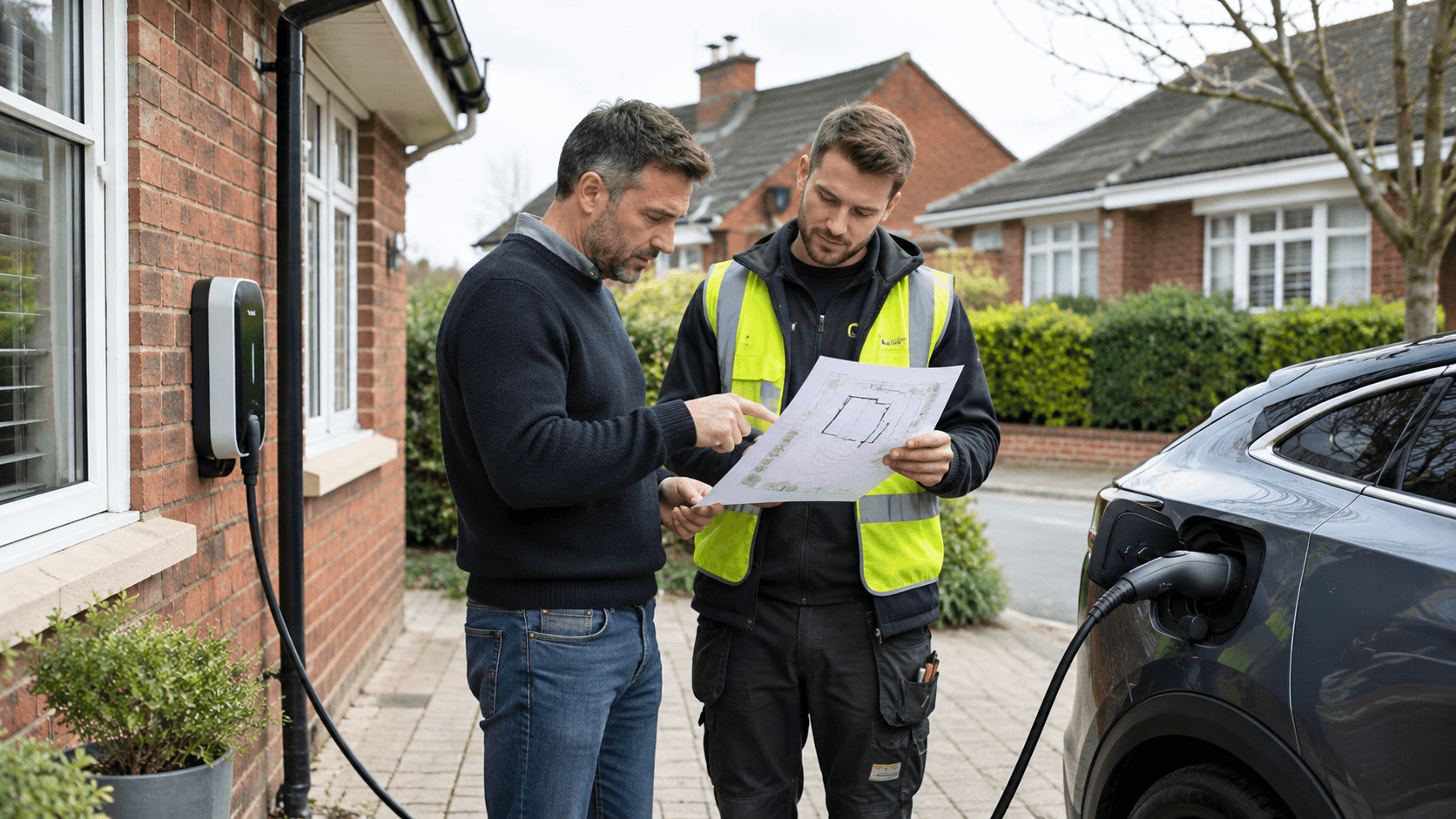
Before installation, the electrician must assess whether your property's electrical installation is suitable for an EV charging point.
An EV charger can place a substantial additional load on a domestic electrical supply.
The installer therefore needs to consider the existing installation and the demand from other electrical equipment.
What Does an EV Charger Electrical Survey Include?
Depending on the property, the assessment may involve checking:
- The incoming electricity supply.
- The main fuse rating.
- The consumer unit and available circuit protection.
- Earthing and bonding arrangements.
- Existing electrical demand.
- The proposed cable route.
- The charger's required electrical protection.
- Whether load management is necessary.
- The suitability of the proposed charger location.
Some checks may be completed using photographs and information provided remotely.
However, an on-site assessment may be necessary where the electrical arrangements are unclear or additional work is anticipated.
Will the Installer Need Access to My Consumer Unit?
Yes, access to the consumer unit will normally be required.
The consumer unit distributes electricity to different circuits within your property.
A dedicated EV charger generally requires an appropriately designed electrical circuit and suitable protective equipment.
The installer must establish how the charger can be connected safely.
If the consumer unit is difficult to access, mention this when requesting a quotation.
Step 4: Check Whether DNO Approval Is Required
One of the less familiar parts of EV charger installation is the role of the electricity distribution network operator, commonly called the DNO.
A DNO is responsible for the local electricity distribution network that supplies homes and businesses.
It is not necessarily the same company as the electricity supplier that sends you your bill.
For example, your electricity supplier might be Octopus Energy, while your local distribution network is operated by a different organisation.
Why Does the DNO Need to Know About an EV Charger?
EV chargers can add significant electrical demand to a property.
Network operators need to understand new electrical loads so they can maintain safe and reliable electricity supplies.
Depending on the property's existing supply and the proposed charger, the installer may be able to notify the DNO after installation or may need to obtain approval before the work proceeds.
The relevant process is generally referred to as connect and notify or apply to connect.
Connect and Notify
Some installations can proceed without waiting for advance DNO approval, provided they meet the applicable criteria.
The installer must then notify the network operator within the required period.
Apply to Connect
Other installations require an application and approval before the charger can be connected.
This may apply where the existing supply is insufficient, the proposed installation exceeds relevant limits or other network conditions require assessment.
In some cases, the DNO may identify the need for additional work.
Who Contacts the DNO?
The electrical installer normally handles the technical notification or application associated with the chargepoint installation.
However, you should confirm this is included in the installation service.
If network upgrades are required, additional arrangements, costs or delays may apply.
For official guidance, see the Energy Networks Association's EV and heat pump connection information (opens in a new tab).
Step 5: Agree the Charger Location and Cable Route
Choosing the correct charger position is an important part of the installation process.
The charger needs to be convenient to use while meeting electrical safety and installation requirements.
A poorly positioned charger can result in inconvenient cable handling, additional installation costs or difficulties when changing vehicles.
Where Should a Home EV Charger Be Installed?
Common locations include:
- An external house wall beside a driveway.
- Inside a garage.
- On the outside wall of a garage.
- A suitable mounting post near a private parking space.
- A designated parking area within the property's boundaries.
The most suitable location depends on the parking arrangement, electrical supply and available cable route.
Consider the Vehicle's Charging Port
Electric vehicles have charging ports in different positions.
Some are located at the front, while others are positioned near the rear or side of the vehicle.
Before choosing a charger location, consider how you normally park.
If you reverse into your driveway, for example, the distance between the charger and the vehicle's charging port may be different from when you park forwards.
Also consider whether the proposed position will remain practical if you change vehicles.
How Far Can the Charger Be From the Consumer Unit?
There is no single maximum cable distance that applies to every installation.
Longer cable runs may be possible, but the electrician must design the circuit appropriately.
Cable size, voltage drop, installation method and protective arrangements all need to be considered.
Longer routes can also increase material and labour costs.
What If the Charger Is Installed on a Detached Garage?
A detached garage may require additional cabling between the main building and the charging location.
Depending on the property, this could involve underground cabling, suitable cable protection and groundworks.
The installer must assess the existing electrical arrangements before deciding how the charger should be supplied.
Step 6: Prepare for Installation Day
Once the quotation is accepted and any necessary approvals are in place, the installer can arrange the installation.
For a straightforward installation, you may not need to do much preparation.
However, providing clear access can help the work proceed smoothly.
Before the Electrician Arrives
Consider the following checklist:
- Make sure the consumer unit and electricity meter are accessible.
- Move vehicles if they obstruct the proposed installation area.
- Clear the wall or garage space where the charger will be mounted.
- Provide access to any relevant indoor rooms or outdoor areas.
- Confirm whether a temporary electricity interruption is expected.
- Make sure someone authorised to discuss the work is available.
- Have any required property permissions ready.
If you live in a rented property, flat or managed development, confirm that any necessary landlord or freeholder permissions have been obtained.
Will the Electricity Need to Be Turned Off?
A temporary electricity interruption is commonly required during part of the installation.
The installer may need to isolate the electrical supply to complete connections safely.
The duration depends on the installation and the work being carried out.
If you rely on equipment that requires continuous electricity, discuss this with the installer beforehand.
Step 7: Install the EV Charging Equipment
The electrician will install the charging point in accordance with the manufacturer's instructions and applicable electrical requirements.
The exact process depends on the charger model and the property's electrical installation.
Mounting the Charger
The charger is fixed to a suitable wall or approved mounting structure.
The installer should position it at an appropriate height and location for safe, practical use.
If the charger is mounted outdoors, the equipment and installation must be suitable for the environmental conditions.
Installing the Electrical Cable
A suitable electrical cable is installed between the charging point and its electrical supply connection.
The cable route may involve:
- Surface-mounted cabling.
- Suitable conduit or trunking.
- Passing cables through walls.
- Routing cables through a garage.
- Underground cabling where necessary.
The installer should use appropriate methods to protect the cable from damage.
Installing Electrical Protection
The charger circuit requires suitable electrical protection.
Depending on the charger and installation design, this may include overcurrent protection, residual current protection and measures addressing relevant earthing and fault conditions.
Some EV chargers incorporate certain protective features internally.
Others require additional external equipment.
The electrician must ensure the overall installation meets the applicable requirements rather than assuming that every charger needs identical external components.
Connecting the Charger
Once the cabling and protective arrangements are complete, the charger is connected to the electrical installation.
The electrician must verify that the connections and equipment are suitable before energising the circuit.
This is specialist electrical work and should not be treated as a DIY installation.
Step 8: Electrical Testing and Safety Checks
After installing the equipment, the electrician must carry out appropriate inspection and testing.
This is an essential part of the installation.
A charger that powers on is not necessarily proof that the electrical installation is safe or compliant.
What Does the Installer Test?
Depending on the installation, testing may include:
- Protective conductor continuity.
- Insulation resistance.
- Polarity.
- Earthing arrangements.
- Earth fault loop impedance.
- Operation of relevant protective devices.
- Functionality of the charging equipment.
- Relevant EV-specific protective features.
The exact tests depend on the installation design and applicable electrical standards.
The installer should identify and resolve any issues before the charging point is put into normal use.
Why Is Electrical Testing Important?
EV charging equipment can operate for several hours at a relatively high electrical load.
Correct circuit design, protective equipment and testing help reduce the risk of electrical faults and unsafe operation.
The installation should comply with applicable requirements, including relevant provisions of BS 7671.
Step 9: Configure the Smart Charger
Once the electrical installation has passed the required checks, the charger can be configured.
Many modern EV chargers connect to a mobile application or online service.
The installer may help you complete the initial setup.
Typical Smart Charger Setup
Depending on the charger, configuration may include:
- Connecting the charger to Wi-Fi or another supported network.
- Registering the equipment with the manufacturer's app.
- Setting charging schedules.
- Configuring available charging limits.
- Checking load management functionality.
- Connecting supported energy monitoring equipment.
- Setting up solar charging features where applicable.
The available functions depend on the model.
Setting Up Overnight Charging
One of the most useful smart charging features is the ability to schedule charging during cheaper electricity periods.
For example, if your electricity tariff offers a discounted rate between midnight and 5am, you may be able to configure the charger to operate during that window.
This can reduce charging costs without changing your daily driving routine.
However, not all EV tariffs operate using fixed overnight periods.
Some intelligent charging products require a compatible vehicle or charger and manage charging automatically.
Our guide to the best EV electricity tariffs in the UK explains how these tariffs work and what to consider before switching.
Step 10: Commissioning and Demonstration
Before leaving, the installer should confirm that the charging point operates correctly.
This process is commonly called commissioning.
The electrician may demonstrate how to connect your vehicle, start and stop charging, and use the charger's main functions.
What Should the Installer Show You?
A useful handover should explain:
- How to start and stop a charging session.
- How to use the cable and connector safely.
- How to operate the charger's app or controls.
- How to configure charging schedules.
- What the charger's indicator lights mean.
- What to do if a fault occurs.
- How to access warranty and manufacturer support.
You should also know who to contact if the charger develops a problem after installation.
What Documents Should You Receive After Installation?
After the work is completed, the installer should provide the documentation appropriate to the electrical work and installation.
This may include:
- An Electrical Installation Certificate.
- Relevant Building Regulations compliance documentation where required.
- Charger manufacturer instructions.
- Warranty information.
- Installation and commissioning records.
- DNO notification or approval details where applicable.
- Grant-related documentation if the installation was supported by an eligible scheme.
The exact documentation depends on the nature of the work and the applicable requirements in your part of the UK.
Do You Need a Building Regulations Certificate?
Certain electrical installation work in dwellings is subject to Building Regulations requirements.
In England, for example, applicable work may need to be notified through a registered competent person scheme or another appropriate building control route.
Requirements differ across England, Wales, Scotland and Northern Ireland.
Ask the installer which certification and notification arrangements apply to your installation.
Keep the documents somewhere safe, as they may be useful for future electrical work, warranty claims or property transactions.
How Long Does It Take to Install a Home EV Charger?
A straightforward installation can often be completed within one working day.
However, the time spent physically installing the charger is only part of the overall process.
Obtaining quotations, arranging surveys and securing any necessary network approvals can take additional time.
What Can Delay an EV Charger Installation?
Potential delays include:
- Additional electrical surveys.
- Consumer unit upgrades.
- Difficult cable routes.
- Groundworks.
- DNO approval.
- Electricity supply upgrades.
- Planning or property permissions.
- Equipment availability.
- Installer scheduling.
A complex installation may require more than one visit.
For example, a detached garage requiring underground cabling may need groundworks before the charger can be connected.
Similarly, a property requiring a supply upgrade may need work from the electricity network operator before installation can proceed.
Do You Need a New Consumer Unit for an EV Charger?
Not necessarily.
Some properties already have a consumer unit that can accommodate the required electrical arrangements.
Others may need additional protection, a separate enclosure or changes to the existing installation.
A complete consumer unit replacement is not automatically required simply because you are installing an EV charger.
The electrician should assess the condition and suitability of the existing equipment.
What If Your Consumer Unit Is Old?
An older consumer unit does not automatically mean the whole installation must be replaced.
However, its condition, available protection and suitability for the proposed work need to be assessed.
If an upgrade is recommended, ask the installer to explain why it is necessary and whether alternative compliant arrangements are available.
Can You Install an EV Charger Without a Driveway?
Possibly, although the process can be more complicated.
If you park on a public road, a charging cable may need to cross a pavement.
This creates additional legal, accessibility and safety considerations.
Some local authorities permit approved cross-pavement charging channels, but policies vary.
You should not assume that a loose cable or temporary cable cover can be used across a public pavement without permission.
The installation may also require highways consent and other approvals.
For a detailed explanation of the options, see our guide to installing an EV charger without a driveway.
Do You Need Planning Permission to Install a Home EV Charger?
Many domestic EV chargepoint installations can be carried out without a separate planning application, provided they meet the applicable permitted development conditions.
However, this depends on the property, charger location and the rules in the relevant part of the UK.
Additional restrictions may apply to:
- Listed buildings.
- Certain conservation or protected areas.
- Installations affecting public highways.
- Some flats and managed developments.
- Installations that do not meet permitted development conditions.
Planning rules differ between England, Scotland, Wales and Northern Ireland.
If you're unsure, check with your local planning authority before arranging installation.
How Much Does a Home EV Charger Installation Cost?
A typical straightforward home EV charger installation in the UK may cost approximately £800 to £1,200, including the charger and standard installation.
However, this is an indicative budgeting range rather than a guaranteed price.
The final cost depends on the charger model and the work required at your property.
What Can Increase the Installation Price?
Common factors include:
- Long cable runs.
- Additional circuit protection.
- Consumer unit alterations.
- Groundworks.
- Detached garage installations.
- Difficult access.
- Supply upgrades.
- Additional electrical repairs.
A quotation should clearly identify the equipment, labour and any additional work.
Can You Get a Government Grant?
Some eligible households can receive financial support towards EV chargepoint installation.
As of November 2026, certain government schemes offer up to £500 towards eligible chargepoint purchase and installation costs, subject to the scheme's conditions.
Eligibility depends on factors such as property type, parking arrangements and the relevant grant scheme.
Homeowners living in ordinary houses they own are generally not eligible for the renters and flat owners grant.
Check the current UK government EV chargepoint grant guidance (opens in a new tab) before arranging installation.
What Happens After Your Home Charger Is Installed?
Once the charger is operational, you can begin using it for regular home charging.
For many EV owners, the main advantage is convenience.
Instead of visiting a public charging station, you can plug in your vehicle when you arrive home.
You may also be able to reduce electricity costs by charging during discounted overnight periods.
How Much Does Home EV Charging Cost?
The running cost depends primarily on the amount of electricity purchased and your electricity tariff.
For example, purchasing 50kWh of electricity from the grid would cost:
| Electricity Rate | Cost of 50kWh |
|---|---|
| 8p per kWh | £4.00 |
| 15p per kWh | £7.50 |
| 26p per kWh | £13.00 |
| 30p per kWh | £15.00 |
These are illustrative electricity rates rather than current supplier quotations.
Actual charging costs depend on the tariff, energy consumed and charging efficiency.
For a more detailed breakdown, read our guide to how much it costs to charge an electric car at home.
Can You Install an EV Charger Yourself?
A dedicated home EV charging point should be installed by a suitably competent electrician with relevant knowledge and experience.
EV charger installation involves electrical design, protective equipment, inspection, testing and potentially network notification or approval.
Incorrect installation can create serious electrical safety risks.
It may also result in non-compliance with applicable regulations or manufacturer requirements.
If you're applying for a government chargepoint grant, the installer must also meet the relevant scheme's authorisation conditions.
Frequently Asked Questions
How Long Does a Home EV Charger Installation Take?
A straightforward installation can often be completed within one working day. However, additional electrical work, groundworks or DNO approval may extend the overall process.
Does an EV Charger Need Its Own Circuit?
A dedicated home EV charger will generally require an appropriately designed electrical circuit and suitable protection. The electrician must assess the installation and follow the relevant electrical requirements.
Will My Electricity Be Turned Off During Installation?
Usually, a temporary interruption will be necessary while the electrician completes electrical connections safely. Ask your installer how long the interruption is expected to last.
Do I Need to Contact My Electricity Supplier?
You generally do not need to change electricity supplier simply to install a home EV charger. However, you may wish to compare EV electricity tariffs after installation.
Does the Installer Contact the DNO?
The installer normally handles the relevant DNO notification or application. Confirm that this is included in the quotation and installation service.
Can an EV Charger Be Installed Outside?
Yes. Many home EV chargers are designed for outdoor installation, provided they are suitable for the location and installed according to the manufacturer's instructions.
Can I Install an EV Charger in a Detached Garage?
Yes, provided the electrical supply and installation arrangements are suitable. Additional cabling, protection or groundworks may be necessary.
Do I Need a New Consumer Unit?
Not always. Some installations can use existing suitable electrical equipment, while others require additional protection or alterations. The electrician should assess the property before recommending upgrades.
Can I Use My EV Charger Immediately After Installation?
Normally, yes, once the installer has completed the required testing, commissioning and handover, and any necessary connection approvals are in place.
Will I Receive an Electrical Certificate?
The installer should provide the appropriate electrical certification for the work carried out. Additional Building Regulations or other compliance documentation may also be required.
Compare Home EV Charger Installation Quotes
Installing a home EV charger involves more than simply mounting a charging unit on a wall.
A safe and reliable installation requires an assessment of your electrical supply, suitable equipment, correct protective measures and appropriate testing.
For many properties, the process is straightforward. Others may require additional planning or electrical work.
Comparing installation quotes can help you understand the requirements of your property and choose a suitable charging solution.
PickASparky helps you find eligible EV charger installers covering your area, allowing you to compare installation options and request quotes.