Best chargers
How to Choose the Best Home EV Charger in the UK (2026 Guide)
Choosing a home EV charger can seem complicated, particularly if you're buying your first electric car. There are numerous charging brands, different power ratings, tethered and untethered models, smart charging features and electricity tariff compatibility requirements to consider.
By PickASparky Team
20 min read
Choosing a home EV charger can seem complicated, particularly if you're buying your first electric car.
There are numerous charging brands, different power ratings, tethered and untethered models, smart charging features and electricity tariff compatibility requirements to consider.
Some chargers are designed for straightforward overnight charging, while others offer advanced energy management, solar panel integration and automatic charging schedules.
But the most expensive charger is not necessarily the best option for your home.
For most UK households, a suitable 7kW smart EV charger provides a practical balance of charging speed, convenience and installation cost. However, the best model depends on your vehicle, electrical supply, parking arrangements and charging habits.
In this guide, we explain what to look for when buying a home EV charger, compare the most important features and help you avoid paying for equipment you don't need.
What Should You Look for in a Home EV Charger?
Before comparing brands or prices, consider how you intend to use your charger.
A homeowner who drives 15 miles per day and charges overnight may have very different requirements from someone who regularly travels 150 miles and needs to recharge quickly between journeys.
Similarly, a household with solar panels may benefit from features that are unnecessary for a property without solar generation.
Home EV Charger Buying Checklist
| Feature | What to Consider | Why It Matters |
|---|---|---|
| Charging power | 3.6kW, 7kW, 11kW or 22kW | Determines potential charging speed |
| Electrical supply | Single-phase or three-phase | Limits available charging power |
| Cable type | Tethered or untethered | Affects convenience and appearance |
| Smart charging | Scheduling and app controls | Helps manage charging costs |
| Tariff compatibility | Supported smart charging services | May unlock discounted electricity |
| Solar integration | Surplus solar charging | Can increase solar self-consumption |
| Load management | Automatic power adjustment | Helps manage household electrical demand |
| Connectivity | Wi-Fi, Ethernet or mobile data | Supports remote monitoring and updates |
| Warranty | Equipment and installation cover | Important for long-term reliability |
| Installation requirements | Cable route and electrical work | Affects total installation cost |
The right charger should meet your everyday requirements without introducing unnecessary complexity.
1. Choose the Right Charging Power
Charging power is one of the first specifications you'll encounter when comparing home EV chargers.
It is measured in kilowatts (kW).
A higher power rating means a charger can potentially deliver electricity more quickly, but only when the electrical supply and vehicle support that power.
3.6kW Home EV Chargers
A 3.6kW charger provides slower charging than a typical 7kW home unit.
It may be suitable for drivers with modest daily mileage or properties where electrical capacity is limited.
However, it can take considerably longer to replenish a large battery.
7kW Home EV Chargers
A 7kW charger is a common domestic choice in the UK.
It generally operates using a suitable single-phase electricity supply and can provide substantial overnight charging.
For example, a charger delivering 7kW over six hours could supply approximately 42kWh of electricity.
The amount stored in the vehicle's battery will be lower because of charging losses.
For many households, this is more than enough to replace the energy used during daily journeys.
11kW and 22kW Home EV Chargers
Higher-powered AC chargers generally require a suitable three-phase electrical supply.
They may be appropriate for certain properties, particularly where faster charging is genuinely necessary.
However, many electric vehicles cannot accept 22kW AC charging.
For example, a vehicle with an 11kW onboard AC charger will not charge at 22kW simply because it is connected to a 22kW charging point.
Before choosing a higher-powered unit, check your vehicle's maximum AC charging capability.
For a detailed comparison, read our guide to 7kW vs 22kW EV chargers.
2. Check Your Home's Electrical Supply
Most UK residential properties have a single-phase electricity supply.
This makes a 7kW charger a practical option for many homes.
However, having a single-phase supply does not automatically mean your property can accommodate a 7kW charger without additional assessment.
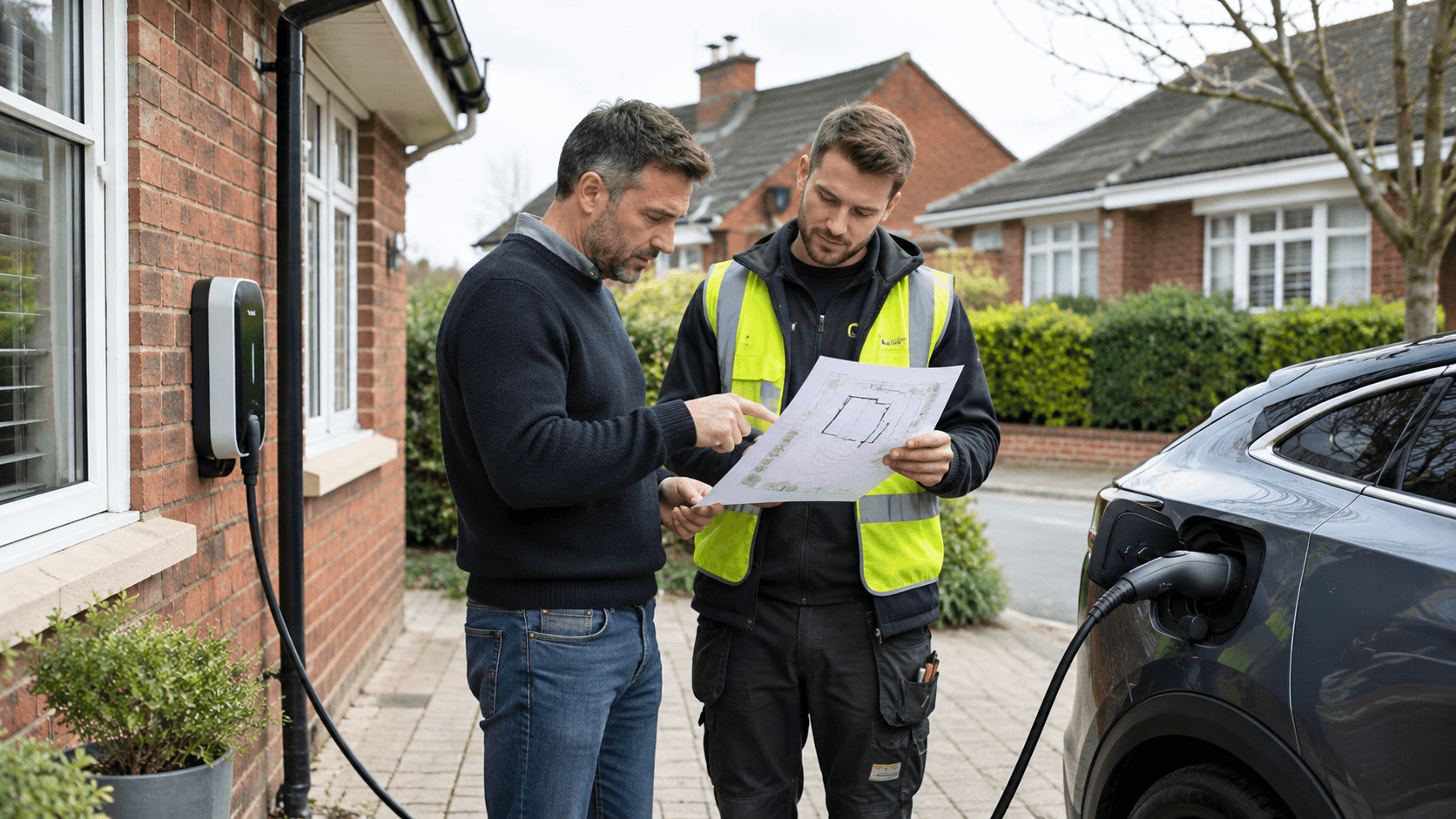
An electrician must consider the existing electrical installation and available capacity.
What Will the Installer Check?
A suitable electrical assessment may include:
- The incoming electricity supply.
- The main fuse rating.
- The consumer unit.
- Earthing and bonding arrangements.
- Existing electrical demand.
- Available circuit protection.
- The proposed charger location.
- Cable routing requirements.
- Whether load management is necessary.
Some properties may require additional electrical protection or other changes.
Others can accommodate a charger without major upgrades.
A qualified installer should explain the requirements before work begins.
3. Decide Between Tethered and Untethered Chargers
Home EV chargers are available with either a permanently attached charging cable or a socket for a detachable cable.
Neither option is automatically better.
The choice mainly affects convenience, appearance and flexibility.
Tethered EV Chargers
A tethered charger includes a permanently attached cable.
This makes everyday charging convenient because the cable is always ready to use.
You simply take the connector and plug it into your vehicle.
Tethered chargers may be particularly suitable for households that charge regularly and have a dedicated parking space.
However, the cable remains visible when not in use and must be stored neatly.
Untethered EV Chargers
An untethered charger has a socket rather than an attached cable.
You connect a separate compatible cable between the charging point and your vehicle.
This can provide a cleaner appearance when the charger is not in use.
It also allows the cable to be removed and replaced separately.
However, you need to handle and store the cable each time you charge.
Which Is Better?
| Consideration | Tethered Charger | Untethered Charger |
|---|---|---|
| Everyday convenience | Generally more convenient | Requires separate cable |
| Appearance | Cable remains visible | Cleaner when not in use |
| Cable replacement | May require specialist work | Usually simpler |
| Cable length | Fixed by attached cable | Flexible cable choice |
| Charging speed | Depends on equipment | Depends on equipment |
| Suitable for home use | Yes | Yes |
If you're undecided, our guide to tethered vs untethered EV chargers explains the practical advantages and disadvantages in more detail.
4. Look for Smart Charging Features
Smart charging is one of the most useful features of a modern home EV charger.
A smart charger can communicate with other systems and provide functions such as charging schedules, energy monitoring and remote controls.
Some chargers can also respond to electricity tariff signals or household energy demand.
Useful Smart Charging Features
Scheduled charging
Allows you to choose when your vehicle charges, which can help you use cheaper overnight electricity.
Mobile app control
Lets you monitor or manage charging through a smartphone.
Energy monitoring
Provides information about electricity consumed during charging sessions.
Dynamic load management
Can reduce charging power when other household appliances increase electrical demand.
Automatic software updates
May provide new functionality, compatibility improvements and security updates.
Solar integration
Allows compatible chargers to make use of surplus solar electricity.
Not every charger offers all these features, and some functions may depend on additional equipment or subscriptions.
Before buying, check which features are included and whether any ongoing fees apply.
5. Check Compatibility With EV Electricity Tariffs
Some UK electricity suppliers offer tariffs designed specifically for electric vehicle charging.
These may provide discounted electricity during overnight periods or use intelligent charging systems to schedule charging automatically.
Choosing a compatible smart charger can make it easier to take advantage of these offers.
Fixed Overnight Tariffs
Some tariffs offer cheaper electricity during a defined period, such as midnight to 5am.
A charger with a reliable scheduling function can help you charge during these hours.
In some cases, you can also schedule charging through your vehicle's built-in settings.
Intelligent EV Charging Tariffs
Other tariffs use smart charging technology to manage eligible charging sessions.
These may require a compatible vehicle, charger or software integration.
Not every charger works with every intelligent tariff.
Before purchasing equipment, check your preferred supplier's compatibility requirements.
Our guide to the best EV electricity tariffs in the UK explains how these tariffs work and what to consider when comparing them.
6. Consider Solar Panel Compatibility
If your home already has solar panels, or you plan to install them, solar compatibility may be an important feature.
A solar-compatible EV charger can monitor available surplus electricity and adjust charging power accordingly.
This can help you use more of the electricity generated by your own solar panels.
What Is Surplus Solar Charging?
Imagine your solar panels are generating 4kW of electricity while your household is using 1kW.
Approximately 3kW may be available for EV charging.
A compatible smart charger can potentially adjust charging power to use this surplus electricity.
However, charging is subject to minimum power requirements, and actual operation depends on the equipment.
Do You Need Solar Integration?
Not necessarily.
A conventional EV charger can still use electricity generated by your solar panels through the household electrical system.
The difference is that a solar-compatible charger may provide more control over when and how that electricity is used.
If solar charging is important to you, check compatibility with your inverter and any home battery system.
For a detailed explanation, read our guide to charging an electric car with solar panels.
7. Check Whether the Charger Supports Load Management
Dynamic load management is a feature that can help prevent a home's electrical demand from exceeding the available supply capacity.
For example, your household may use several high-power appliances at the same time.
These could include an electric shower, oven, heat pump or other electrical equipment.
If the EV charger is also operating at full power, the combined demand may become significant.
A suitable load management system can monitor electricity consumption and reduce EV charging power when necessary.
Is Dynamic Load Management Essential?
Not every installation requires the same load management arrangements.
The need depends on the electrical supply, existing household demand and installation design.
A qualified electrician should assess whether load management is necessary or beneficial.
Some chargers include load management functionality, while others require additional monitoring equipment.
Check what is included in the quoted installation package.
8. Consider Charger Connectivity
Many smart EV chargers require an internet connection for certain features.
Depending on the model, connectivity may be provided through:
- Wi-Fi.
- Ethernet.
- Mobile data.
- Other supported communication methods.
Connectivity can be important for app control, software updates, energy monitoring and intelligent tariff integration.
What If Your Wi-Fi Signal Is Weak?
If the charger will be installed outside or in a detached garage, check whether the proposed location has reliable connectivity.
A weak signal may affect some smart functions.
Certain chargers offer mobile data connectivity or other alternatives.
Ask the installer whether additional networking equipment is needed before purchasing the charger.
Will the Charger Work Without Internet?
This depends on the model.
Some chargers can continue basic charging when the internet connection is unavailable, while cloud-based features may stop working temporarily.
Others may have additional restrictions or operating requirements.
Check the manufacturer's documentation for offline operation and recovery behaviour.
9. Think About Charger Location and Cable Length
The position of your charger can affect both convenience and installation cost.
Ideally, the charger should be easy to reach from your normal parking position without creating unnecessary cable hazards.
Consider the location of your vehicle's charging port.
Different vehicles have charging ports at the front, rear or side.
What Cable Length Do You Need?
Common charging cable lengths include approximately 5 metres and 7.5 metres, although other options are available.
A longer cable may provide flexibility, but it can also be heavier and less convenient to store.
A cable that is too short may make charging difficult when parking arrangements change.
Before choosing a tethered charger, check that the attached cable will reach your vehicle comfortably.
What If You Have a Detached Garage?
A detached garage may require additional electrical cabling or groundworks.
The installation may also need suitable cable protection and electrical arrangements.
These factors can increase the total cost.
For more information about the installation process, see our step-by-step home EV charger installation guide.
10. Compare Popular Home EV Charger Brands
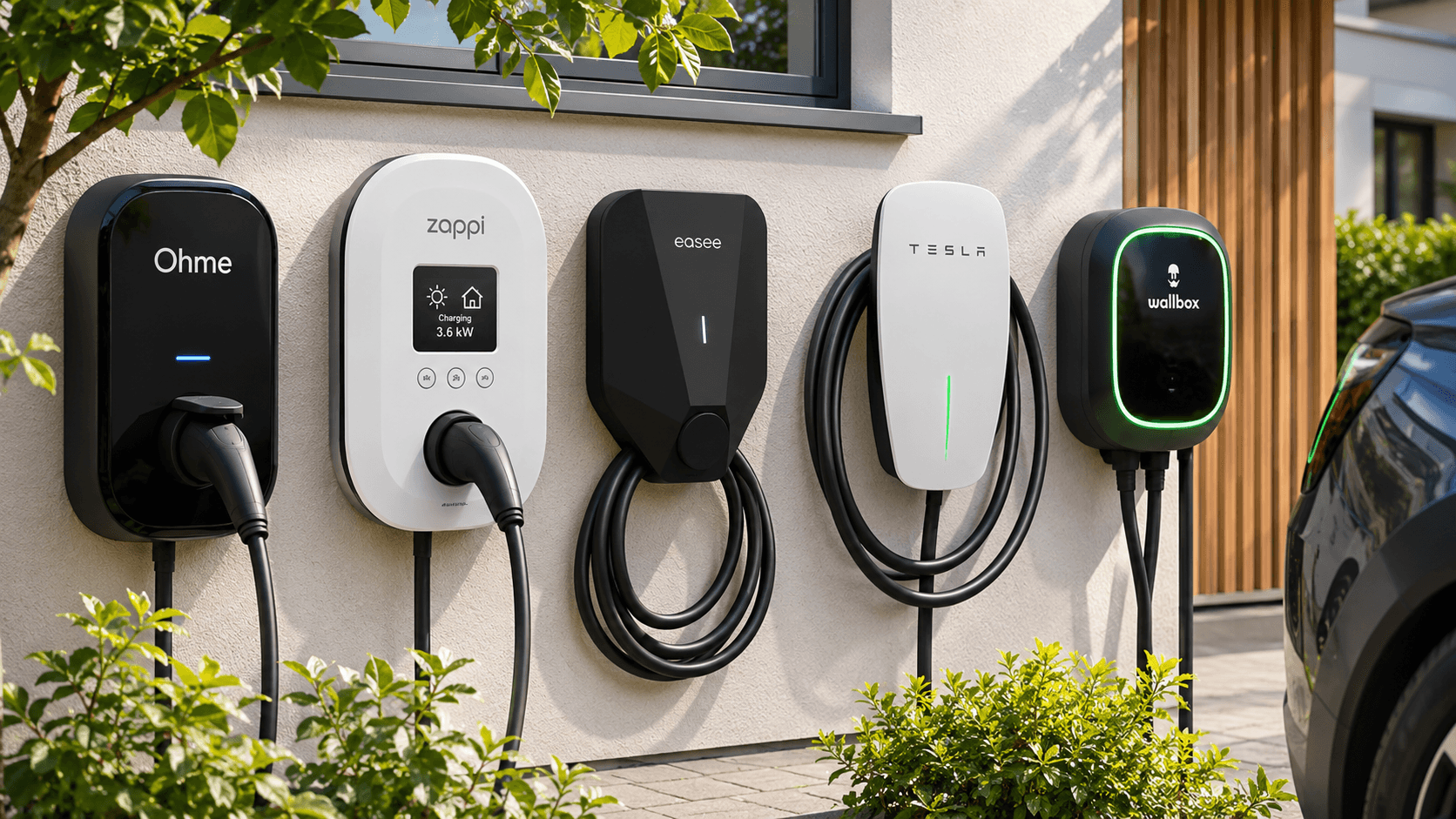
Several manufacturers supply home EV chargers in the UK.
Different brands focus on different combinations of smart charging, appearance, solar integration and ease of use.
The following are examples of established charger brands rather than a ranking of the best products.
Ohme
Ohme offers smart home EV charging equipment with features designed around charging schedules and electricity tariff integration.
Its product range includes tethered and untethered options.
Ohme may appeal to drivers who want smart charging functionality and compatibility with supported energy tariffs.
myenergi zappi
The myenergi zappi is particularly well known for its solar-compatible charging features.
It can be suitable for households with solar PV systems or those planning to install renewable energy equipment.
However, the value of its solar features depends on the household's actual electricity generation and charging habits.
Easee
Easee offers compact smart charging equipment with connectivity and energy management features.
Its products may appeal to homeowners who prefer a relatively discreet charging unit.
When comparing models, check the exact UK product specification, electrical protection requirements and current compliance documentation.
Hypervolt
Hypervolt offers smart home charging equipment with app-based controls and energy management features.
Its chargers are often considered by homeowners who value appearance, connectivity and smart charging functionality.
Check the current model's supported features and tariff integrations before purchasing.
Andersen
Andersen chargers are known for their design-focused approach and cable management options.
They may appeal to homeowners who want a charging point that blends into the appearance of their property.
However, premium design features can affect the equipment price.
Tesla Wall Connector
Tesla offers its Wall Connector for compatible electric vehicles.
The current European Type 2 version can also be used with other compatible EVs, subject to the product's specifications.
However, Tesla ownership is not a requirement for every home charging installation.
How Should You Compare Charger Brands?
Rather than choosing solely by brand recognition, compare:
- The exact model's charging power.
- Tethered or untethered configuration.
- Smart charging functionality.
- Electricity tariff compatibility.
- Solar integration.
- Connectivity requirements.
- Warranty and support.
- Installation requirements.
- Total installed price.
Product specifications and supported features can change between model generations.
Always check the current manufacturer's documentation before making a final decision.
11. Compare the Total Installation Cost
The purchase price of the charger is only part of the overall expense.
You also need to consider the electrical installation.
A straightforward home EV charger installation in the UK may cost approximately £800–£1,200, including equipment and standard installation.
However, actual quotations vary.
What Can Increase Installation Costs?
Potential additional expenses include:
- Long electrical cable runs.
- Consumer unit alterations.
- Additional electrical protection.
- Groundworks.
- Detached garage installations.
- Supply upgrades.
- Difficult access.
- Specialist mounting arrangements.
A charger that appears inexpensive online may not provide the best overall value if the installation package excludes important work.
Should You Buy the Charger Separately?
Some electricians offer supply-and-installation packages, while others allow customers to purchase their own equipment.
Buying separately may sometimes reduce the equipment price.
However, confirm that your installer is willing to fit the model and that warranty responsibilities are clear.
For more information, read our guide to how much EV charger installation costs in the UK.
12. Check the Warranty and After-Sales Support
A home EV charger is equipment you may use regularly for many years.
Warranty and manufacturer support are therefore important considerations.
Before purchasing, check:
- The manufacturer's warranty period.
- What components are covered.
- Whether labour is included in warranty repairs.
- Whether installation workmanship has separate cover.
- How faults are diagnosed.
- Whether replacement parts are available.
- Whether customer support is UK-based.
- What happens if the charger loses internet connectivity.
Some smart chargers rely on cloud-based services for certain features.
It is worth checking how the charger operates if those services are temporarily unavailable.
A lower purchase price may not be worthwhile if the product has limited support or expensive repair arrangements.
13. Consider Your Future Charging Needs
When choosing a charger, think beyond your current vehicle.
You may eventually buy another electric car, change your parking arrangements or install solar panels.
However, future-proofing does not necessarily mean purchasing the most powerful or expensive charger.
For many households, a suitable 7kW smart charger will remain practical for years.
What Features Are Worth Future-Proofing?
Depending on your circumstances, useful considerations include:
- Reliable smart charging functionality.
- Compatibility with common Type 2 vehicles.
- Flexible charging schedules.
- Suitable cable length.
- Solar integration if you plan to install panels.
- Load management capability.
- Manufacturer software support.
- A practical charger location.
If you expect to own two electric vehicles, also consider how charging will be shared.
Two vehicles do not automatically require two chargers, but your household's mileage and charging schedules will determine whether one is sufficient.
How Much Does It Cost to Run a Home EV Charger?
The charger's brand and appearance generally have less influence on running costs than the electricity tariff and amount of energy consumed.
For example, suppose you purchase 50kWh of electricity from the grid for charging.
| Electricity Rate | Cost of 50kWh |
|---|---|
| 8p per kWh | £4.00 |
| 15p per kWh | £7.50 |
| 26p per kWh | £13.00 |
| 30p per kWh | £15.00 |
These are illustrative rates, not current supplier quotations.
A smart charger that helps you use discounted overnight electricity may therefore provide financial benefits over time.
However, the savings depend on your electricity tariff, driving habits and how consistently you charge during cheaper periods.
For a more detailed breakdown, read our guide to how much it costs to charge an electric car at home.
What If You Don't Have a Driveway?
Not having a private driveway can make home EV charging more complicated.
If you park on a public road, a charging cable may need to cross a pavement.
You should not assume that running a loose cable or using a temporary cable cover is permitted.
Some local authorities allow approved cross-pavement charging solutions, but the rules and availability vary.
You may need highways consent and other permissions before installation.
If this applies to your property, read our guide to installing an EV charger without a driveway.
Common Mistakes to Avoid When Buying a Home EV Charger
Choosing a charger without considering your property and vehicle can lead to unnecessary costs or inconvenience.
Buying a 22kW Charger Without Checking Your Supply
Most UK homes have single-phase electricity.
A 22kW charger generally requires three-phase electricity to operate at full power.
Check your electrical supply and vehicle compatibility before paying for higher-powered equipment.
Choosing a Charger Based Only on Price
A cheaper charger may lack features that are important to your charging routine.
However, paying more for features you will never use is equally unnecessary.
Compare the total value of the equipment and installation.
Ignoring Electricity Tariff Compatibility
Some intelligent EV tariffs require compatible charging equipment.
If discounted smart charging is important to you, check compatibility before purchasing.
Choosing the Wrong Cable Length
A cable that is too short can make charging inconvenient.
Consider the position of your vehicle's charging port and how you normally park.
Overlooking Connectivity
A charger installed outside or in a detached garage may have weak Wi-Fi coverage.
Check connectivity requirements before installation.
Not Comparing Installation Quotes
Different installers may recommend different solutions.
Obtaining comparable quotations can help you understand the work required and avoid unnecessary expenses.
Frequently Asked Questions
What Is the Best Home EV Charger in the UK?
There is no single best charger for every household. The most suitable model depends on your vehicle, electrical supply, budget and charging habits. For many UK homes, a 7kW smart charger is a practical choice.
Is a 7kW Home Charger Enough?
For many drivers, yes. A 7kW charger can provide substantial overnight charging and is commonly suited to properties with a suitable single-phase electricity supply.
Which EV Charger Works Best With Solar Panels?
A charger with compatible surplus solar charging and energy monitoring features may be useful. The best model depends on your solar inverter, electrical installation and charging requirements.
Is a Tethered or Untethered Charger Better?
Tethered chargers are generally more convenient for frequent charging, while untethered chargers offer a cleaner appearance and flexible cable replacement. Both can provide similar charging performance.
Do I Need a Smart EV Charger?
A smart charger is a common choice for new UK domestic installations, and relevant UK regulations require certain smart functionality for many private chargepoints sold for domestic or workplace use. Exact requirements and exemptions depend on the jurisdiction and equipment.
Can Any Electric Car Use a Home EV Charger?
Compatibility depends on the vehicle's charging connector, onboard charger and the charging equipment. Most modern UK electric cars use Type 2 AC charging, but you should check the specifications of your particular vehicle.
How Much Does a Home EV Charger Cost to Install?
A straightforward installation may cost approximately £800–£1,200 including equipment and standard installation. More complex properties can require additional work and higher expenditure.
Do I Need a Three-Phase Supply?
Not for a typical 7kW domestic charger. A 22kW AC charger generally requires a suitable three-phase supply to operate at full power.
Can I Change My EV Charger Later?
Yes, but replacement should be assessed and carried out by a suitably competent electrician. Existing cabling and protective equipment may be reusable if they are suitable for the new charger.
Is It Better to Buy a Charger From the Installer?
A combined supply-and-installation package can be convenient because equipment and installation responsibilities may be clearer. However, buying separately may sometimes offer savings. Compare the total cost and warranty arrangements.
Compare Home EV Charger Installation Quotes
The best home EV charger is not necessarily the fastest, most expensive or most feature-packed model.
It is the charger that works reliably with your vehicle, suits your property's electrical supply and makes everyday charging convenient.
For many UK households, a suitable 7kW smart charger provides an effective balance of charging speed, cost and functionality.
However, the final decision should be based on your property and charging requirements.
A qualified installer can assess your electrical installation and recommend suitable equipment without unnecessary upgrades.
PickASparky helps you find eligible EV charger installers covering your area, allowing you to compare installation options and request quotes.