Charging times
How Long Does It Take to Charge an Electric Car at Home? (UK Guide)
One of the first questions people ask when considering an electric vehicle is how long it takes to charge at home. Unlike filling a petrol or diesel car, charging an electric vehicle usually takes place while the car is parked. For many drivers, this means plugging in overnight and starting the fol
By PickASparky Team
20 min read
One of the first questions people ask when considering an electric vehicle is how long it takes to charge at home.
Unlike filling a petrol or diesel car, charging an electric vehicle usually takes place while the car is parked. For many drivers, this means plugging in overnight and starting the following morning with enough battery charge for the day's journeys.
But charging times can vary considerably.
A standard UK three-pin socket may take more than 24 hours to recharge a large electric car battery, while a dedicated 7kW home EV charger can complete the same task much faster.
For many electric cars, a 7kW home charger can replenish a battery from 20% to 80% in approximately four to eight hours, depending on battery size, vehicle capabilities and charging conditions.
In this guide, we explain how long it takes to charge an electric car at home, compare different charger speeds and show you how to calculate charging times for your own vehicle.
How Long Does It Take to Charge an Electric Car at Home?
The time required to charge an electric car depends mainly on three factors:
- The size of the vehicle's battery.
- The power available from the charging point.
- The vehicle's maximum AC charging capability.
Other factors, including temperature, charging losses and household electrical demand, can also affect charging time.
For example, a small electric car with a 40kWh battery will generally take less time to charge than a large electric SUV with a 90kWh battery when using the same charger.
Similarly, a dedicated 7kW charger can deliver electricity much faster than a typical three-pin domestic socket.
EV Charging Times at a Glance
The following table shows approximate times to charge different battery sizes from 20% to 80%.
| Battery Size | 2.3kW Plug | 3.6kW Charger | 7kW Charger | 11kW Charger | 22kW Charger |
|---|---|---|---|---|---|
| 40kWh | 11h 36m | 7h 24m | 3h 49m | 2h 25m | 1h 13m |
| 50kWh | 14h 30m | 9h 16m | 4h 46m | 3h 02m | 1h 31m |
| 60kWh | 17h 23m | 11h 07m | 5h 43m | 3h 38m | 1h 49m |
| 75kWh | 21h 44m | 13h 53m | 7h 09m | 4h 33m | 2h 16m |
| 90kWh | 26h 05m | 16h 40m | 8h 34m | 5h 27m | 2h 44m |
Illustrative estimates assuming usable battery capacity, 90% charging efficiency and constant charging power. The 11kW and 22kW figures require a suitable electrical supply and compatible vehicle. Actual charging times may be longer.
For most UK households, a 7kW charger offers a practical balance between charging speed and installation requirements.
How Long Does a 7kW EV Charger Take?
A 7kW home EV charger is one of the most common options for UK residential properties.
It is typically suitable for a correctly assessed single-phase electricity supply.
At its rated output, a 7kW charger can deliver approximately 7kWh of electricity per hour.
However, not all the electricity drawn from the supply is stored in the vehicle's battery because some energy is lost during charging.
Example: Charging a 60kWh Electric Car
Suppose your electric car has a usable battery capacity of 60kWh.
You arrive home with 20% battery remaining and want to charge to 80%.
The energy you need to add to the battery is:
60kWh × 60% = 36kWh.
Assuming 90% charging efficiency, the electricity required from the supply is approximately:
36 ÷ 0.90 = 40kWh.
At 7kW:
40 ÷ 7 = approximately 5.7 hours.
Therefore, charging from 20% to 80% would take approximately 5 hours and 43 minutes under these assumptions.
Is a 7kW Charger Enough for Overnight Charging?
For many drivers, yes.
If your vehicle is parked at home for eight to ten hours overnight, a 7kW charger can replenish a substantial amount of energy.
This is often more than enough to replace the electricity consumed during everyday driving.
However, the required charging time depends on how much battery energy you need to restore.
If you regularly arrive home with 70% battery remaining, you may only need a short charging session.
If you arrive with 10% remaining after a long journey, charging will take considerably longer.
For a comparison of domestic charger power ratings, read our guide to 7kW vs 22kW EV chargers.
How Long Does It Take to Charge an EV Using a Three-Pin Plug?
A standard UK three-pin socket can charge some electric vehicles using suitable manufacturer-approved portable charging equipment.
However, this is much slower than using a dedicated home EV charger.
A typical portable charging arrangement may draw around 2.3kW, depending on its current setting and the electrical installation.
Example: Charging a 60kWh Battery
Using the same 20% to 80% example:
- Battery energy required: 36kWh.
- Electricity required at 90% efficiency: 40kWh.
- Charging power: 2.3kW.
Estimated charging time:
40 ÷ 2.3 = approximately 17.4 hours.
That is around 17 hours and 23 minutes.
Charging the same battery from 0% to 100% could take approximately 29 hours under these assumptions.
Is It Safe to Charge an EV From a Three-Pin Socket?
Charging through a domestic socket should generally be treated as an occasional or temporary solution rather than the preferred arrangement for regular home charging.
EV charging places a sustained electrical load on the socket and associated wiring.
Before using a domestic socket for EV charging, have a competent electrician confirm that the electrical installation and socket are suitable.
Use only approved charging equipment and follow the vehicle and equipment manufacturers' instructions.
Do not use ordinary extension leads or multi-plug adaptors for EV charging.
For regular charging, a properly installed dedicated EV chargepoint is generally the more suitable option.
How Long Does a 3.6kW EV Charger Take?
A 3.6kW charger delivers more power than a typical three-pin socket but approximately half the power of a 7kW charger.
It may be suitable where electrical capacity is limited or where slower charging meets the household's needs.
For example, charging a 60kWh battery from 20% to 80% at 3.6kW would take approximately 11 hours and 7 minutes, assuming 90% efficiency.
This may still be practical for overnight charging, particularly for drivers with modest daily mileage.
However, if you regularly need to replenish a large amount of energy, a 7kW charger may be more convenient.
How Long Does an 11kW EV Charger Take?
An 11kW charger can deliver electricity faster than a 7kW charger when the vehicle and electrical installation support that power.
However, an 11kW AC charger generally requires a suitable three-phase electricity supply.
Most UK domestic properties have single-phase supplies.
Example: Charging a 60kWh Battery
Charging from 20% to 80% requires 36kWh of battery energy.
Allowing for 90% charging efficiency:
36 ÷ (11 × 0.90) = approximately 3.64 hours.
That is approximately 3 hours and 38 minutes.
However, this assumes the vehicle can accept 11kW AC charging.
If the vehicle's onboard charger is limited to 7kW, connecting it to an 11kW charging point will not increase its charging speed beyond that limit.
How Long Does a 22kW EV Charger Take?
A 22kW charger can theoretically deliver electricity approximately three times faster than a 7kW charger.
However, achieving that speed requires both a suitable three-phase electrical supply and a vehicle capable of accepting 22kW AC charging.
Many electric vehicles have maximum AC charging rates of 7kW or 11kW.
This means they cannot take full advantage of a 22kW charging point.
Example: Charging a 60kWh Battery
Assuming the vehicle supports 22kW AC charging:
36 ÷ (22 × 0.90) = approximately 1.82 hours.
That is approximately 1 hour and 49 minutes.
However, if the vehicle can only accept 11kW AC charging, the same session would take approximately 3 hours and 38 minutes.
A more powerful charging point does not automatically mean faster charging.
Before paying for a higher-powered charger, check the vehicle's maximum AC charging capability and your property's electrical supply.
EV Charging Time Calculator
You can estimate how long your electric car will take to charge using a simple calculation.
Charging Time Formula
Charging time (hours) = Battery energy required (kWh) ÷ (Effective charging power (kW) × Charging efficiency)
First, calculate how much energy you want to add to the battery.
Battery energy required = Usable battery capacity × (Target charge % − Starting charge %) ÷ 100
For AC charging, the effective charging power is limited by the lowest applicable limit, including the charging point, the vehicle's onboard charger and any active electrical load restrictions.
Example Calculation
Suppose you have:
- Usable battery capacity: 70kWh.
- Starting charge: 30%.
- Target charge: 90%.
- Effective charging power: 7kW.
- Charging efficiency: 90%.
Step 1: Calculate the energy required
70 × (90 − 30) ÷ 100 = 42kWh.
Step 2: Calculate the charging time
42 ÷ (7 × 0.90) = 6.67 hours.
Estimated charging time: 6 hours and 40 minutes.
This is a simplified estimate. Real charging power and efficiency may vary throughout the session.
How Long Does It Take to Add 100 Miles of Range?
You do not necessarily need to fully charge your electric car every time you plug it in.
For everyday driving, a more useful question may be how long it takes to replace the range used during a journey.
Suppose your electric car averages 3.5 miles per kWh of battery energy.
To add approximately 100 miles of driving range, you would need:
100 ÷ 3.5 = approximately 28.6kWh of battery energy.
Allowing for 90% charging efficiency, the electricity required from the supply would be approximately 31.7kWh.
Time to Add Approximately 100 Miles
| Charging Power | Estimated Charging Time |
|---|---|
| 2.3kW | 13h 48m |
| 3.6kW | 8h 49m |
| 7kW | 4h 32m |
| 11kW | 2h 53m |
| 22kW | 1h 27m |
Illustrative figures assuming 3.5 miles/kWh, 90% charging efficiency and a vehicle capable of accepting the stated power.
Actual driving range depends on vehicle efficiency, speed, weather, road conditions and driving style.
How Many Miles of Range Can You Add Per Hour?
Another way to compare charging speeds is to estimate the driving range added during one hour of charging.
Using an assumed vehicle efficiency of 3.5 miles per kWh and 90% charging efficiency:
| Charging Power | Approximate Miles Added Per Hour |
|---|---|
| 2.3kW | 7 miles |
| 3.6kW | 11 miles |
| 7kW | 22 miles |
| 11kW | 35 miles |
| 22kW | 69 miles |
Rounded illustrative figures. The 11kW and 22kW examples require compatible vehicles and suitable supplies.
For someone driving 30 miles per day, a 7kW charger could theoretically replace the energy used in approximately 1 hour and 22 minutes.
This helps explain why many EV owners do not need to charge their vehicles from empty to full every night.
What Factors Affect Electric Car Charging Time?
The charger's advertised power rating is only one factor.
Several conditions can influence the actual time required.
1. Battery Capacity
Larger batteries generally require more energy to charge.
A 90kWh battery will usually take longer to charge than a 40kWh battery when both start at the same percentage and use the same charging power.
2. Starting Battery Percentage
Charging from 10% to 80% requires more energy than charging from 60% to 80%.
The lower your starting battery level, the more energy you may need to replenish.
3. Maximum AC Charging Rate
Your vehicle's onboard AC charger determines how much AC charging power it can accept.
For example, a car limited to 7kW AC charging will not charge at 22kW when connected to a 22kW AC charging point.
4. Household Electrical Demand
Some smart EV chargers include dynamic load management.
This feature can reduce charging power when other household appliances are consuming substantial electricity.
For example, the charger may temporarily lower its output when an electric shower or other high-power appliance is operating.
This can extend the charging session.
5. Battery Temperature
Very cold or hot conditions can affect charging efficiency and the charging power accepted by the vehicle.
The battery management system may also use energy to heat or cool the battery.
6. Charging Efficiency
Not all electricity purchased from the grid reaches the battery.
Energy is lost through conversion, cabling, electronics and battery conditioning.
The actual efficiency depends on the vehicle and charging conditions.
7. Charging Schedules
A smart charger may delay charging until a selected time.
For example, if you plug in at 7pm but schedule charging to start at midnight, the vehicle will remain connected without charging for several hours.
The charging session itself may take five hours, even though the vehicle has been plugged in for ten hours.
Does Charging Slow Down After 80%?
Electric vehicles can reduce charging power as the battery approaches a high state of charge.
This behaviour is particularly noticeable when using public DC rapid chargers.
The battery management system controls charging to maintain safe operating conditions.
With home AC charging, the effect can be less dramatic because the charging power is already relatively low.
However, some vehicles may still reduce charging power near full charge or under certain temperature conditions.
Therefore, charging from 80% to 100% does not always take exactly the same time as charging from 60% to 80%.
For accurate estimates, consult your vehicle manufacturer's charging specifications.
Should You Charge Your Electric Car to 100% Every Night?
Not necessarily.
The recommended charging limit depends on the vehicle and battery chemistry.
Some manufacturers recommend setting a lower charge limit for routine daily use.
Others recommend different charging practices for particular battery types.
For example, certain lithium iron phosphate (LFP) batteries may have different manufacturer recommendations from nickel-rich lithium-ion batteries.
The most reliable approach is to follow your vehicle manufacturer's guidance.
If you only need enough range for normal daily journeys, charging to 100% may not be necessary every night.
However, a full charge may be useful before a long journey where the manufacturer permits it.
Can You Charge an Electric Car Overnight?
Yes. Overnight charging is one of the main advantages of having a dedicated home EV charger.
Most vehicles spend several hours parked at home, providing ample time for regular charging.
A compatible smart charger can also schedule charging during cheaper electricity periods.
Example: Charging Overnight
Suppose you arrive home at 6pm with 30% battery remaining.
Your electric car has a 60kWh usable battery, and you want to charge to 80%.
The energy required is:
60 × 50% = 30kWh.
At 7kW with 90% efficiency:
30 ÷ (7 × 0.90) = approximately 4 hours and 46 minutes.
You could schedule charging to begin at midnight and expect the target to be reached before 5am under the assumed conditions.
However, actual charging time may vary.
Can Overnight Charging Save Money?
Potentially.
Some UK electricity suppliers offer discounted overnight EV charging rates.
For example, purchasing 40kWh of electricity at 8p per kWh would cost £3.20.
At 26p per kWh, the same electricity would cost £10.40.
These are illustrative rates rather than current supplier quotations.
Our guide to the best EV electricity tariffs in the UK explains how to compare charging tariffs.
You can also read our detailed guide to how much it costs to charge an electric car at home.
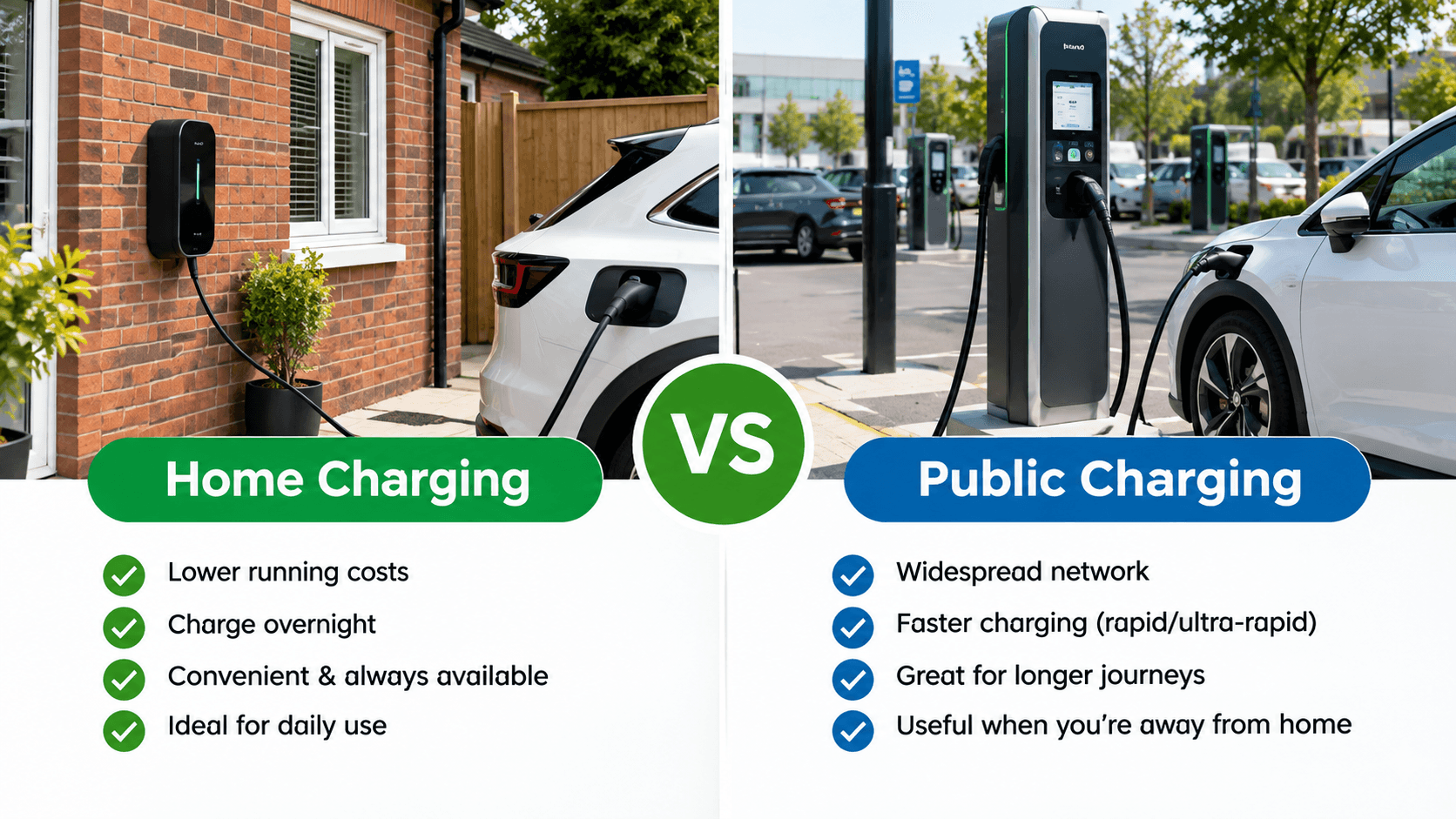
Is Home Charging Slower Than Public Rapid Charging?
Generally, yes.
Dedicated home EV chargers usually deliver AC electricity at around 7kW.
Public rapid chargers deliver DC electricity at substantially higher power levels.
For example, some public rapid chargers are rated at 50kW, while ultra-rapid charging equipment may offer 150kW, 350kW or higher.
However, the vehicle must support the available charging power.
Home vs Public Charging Speeds
| Charging Method | Typical Power | Main Use |
|---|---|---|
| Three-pin domestic socket | Around 2.3kW | Occasional charging |
| Dedicated home charger | Around 7kW | Overnight charging |
| Public AC charger | 7–22kW | Destination charging |
| Public rapid DC charger | 50kW | Charging during journeys |
| Public ultra-rapid DC charger | 100–350kW+ | Faster journey charging |
Public rapid charging is useful for long journeys, but it can cost considerably more than charging at home.
Our guide to home EV charging vs public charging compares electricity costs, convenience and potential annual savings.
Can Solar Panels Charge an EV Fast Enough?
Solar panels can provide electricity for home EV charging, but the available power changes throughout the day.
For example, if your solar system has 3kW of surplus electricity available, a compatible smart charger may be able to use that energy for charging.
However, the charging power may fall when cloud cover reduces generation or household appliances consume more electricity.
This means solar-only charging can take longer than charging continuously at the full rated output of a 7kW charger.
Can You Combine Solar and Grid Charging?
Yes.
Some solar-compatible EV chargers offer modes that combine available solar electricity with grid electricity.
This can help maintain a higher charging rate when solar generation is insufficient.
Other modes prioritise surplus solar electricity and may pause charging when generation falls below the required minimum.
Our guide to charging an electric car with solar panels explains these options in more detail.
Does a Tethered Charger Charge Faster Than an Untethered Charger?
Not inherently.
A tethered charger has a permanently attached cable, while an untethered charger uses a separate detachable cable.
Both can provide similar charging speeds when the equipment and cables are correctly rated.
For example, a tethered 7kW charger and an untethered 7kW charger can both deliver approximately 7kW to a compatible vehicle.
However, a detachable cable with a lower current rating may limit the available charging power in some installations.
For a complete comparison, read our guide to tethered vs untethered EV chargers.
Is It Worth Installing a Faster Home EV Charger?
That depends on your vehicle, property and driving habits.
For many households, a 7kW charger provides sufficient overnight charging.
A higher-powered charger may be useful if you have a suitable three-phase electricity supply, a compatible vehicle and a genuine need for faster AC charging.
However, upgrading the electricity supply solely to support a 22kW charger can be expensive.
Questions to Consider
Before choosing a charger, ask yourself:
- How many miles do I drive each day?
- How long is my vehicle parked at home overnight?
- What is my vehicle's maximum AC charging rate?
- Does my property have single-phase or three-phase electricity?
- Do I need to charge more than one electric vehicle?
- Would a discounted overnight tariff cover my charging needs?
- Will I install solar panels in the future?
The answers can help you choose equipment that meets your requirements without unnecessary expenditure.
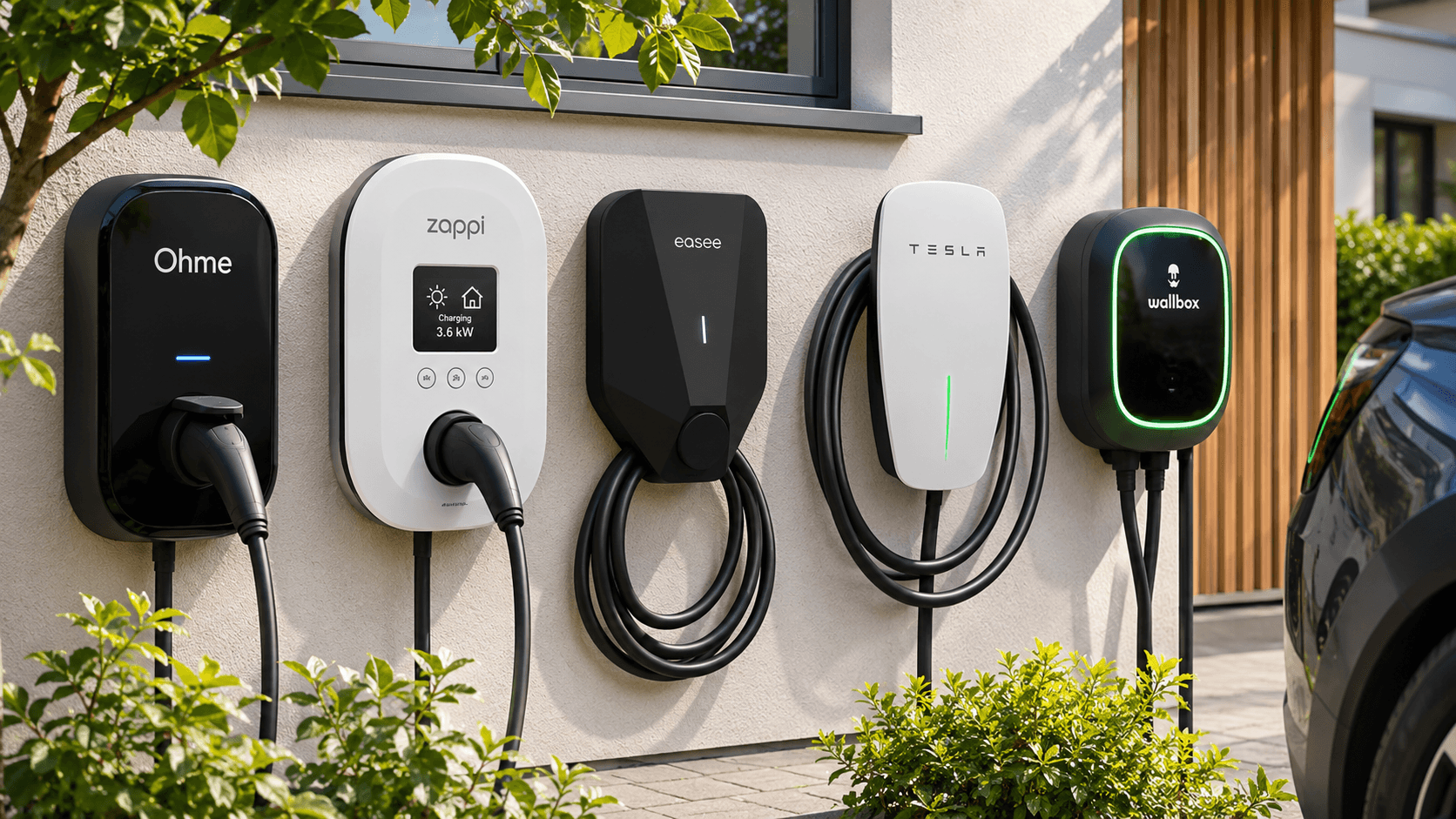
Our guide to choosing the best home EV charger in the UK covers the most important features and buying considerations.
How Much Does a Faster Home EV Charger Cost to Install?
The installation cost depends on the charger model and electrical work required.
A straightforward 7kW home EV charger installation may cost approximately £800–£1,200, including equipment and standard installation.
However, this is an indicative budgeting range rather than a guaranteed quotation.
Additional costs may arise from:
- Long electrical cable runs.
- Consumer unit alterations.
- Electrical supply upgrades.
- Groundworks.
- Detached garage installations.
- Additional electrical protection.
- Complex mounting arrangements.
A three-phase installation may involve additional electrical work, particularly if the property does not already have a suitable supply.
For a full breakdown, read our guide to EV charger installation costs in the UK.
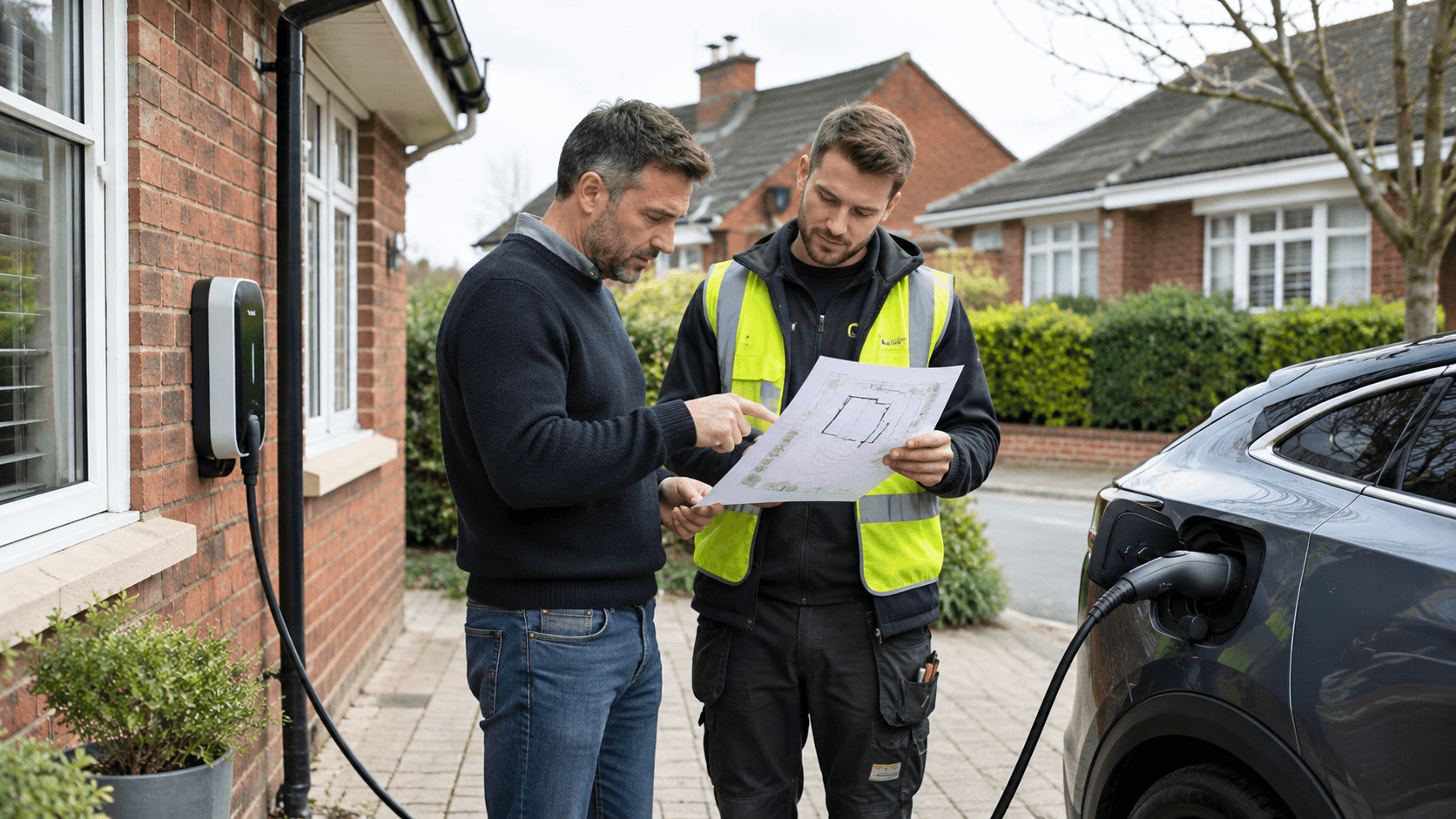
If you're unfamiliar with the process, our step-by-step home EV charger installation guide explains what happens from the initial survey to testing and certification.
What If You Cannot Install a Home EV Charger?
Not every property has a private driveway or dedicated parking space.
If you live in a flat or terraced house, you may need to consider alternative charging arrangements.
These could include:
- Public on-street charging points.
- Workplace charging.
- Communal residential charging.
- Destination charging.
- Approved cross-pavement charging solutions.
The availability of these options depends on your property and local infrastructure.
For more information, read our guide to installing an EV charger without a driveway.
If you're planning a new installation, it is also worth checking whether any property permissions are necessary.
Our guide to EV charger planning permission in the UK explains the rules for houses, flats, listed buildings and on-street charging.
Frequently Asked Questions
How Long Does It Take to Charge an Electric Car at Home With a 7kW Charger?
For many electric cars, charging from 20% to 80% takes approximately four to eight hours using a 7kW charger. The exact time depends on battery capacity, charging efficiency and vehicle limitations.
How Long Does It Take to Fully Charge a 60kWh EV Battery?
At 7kW with 90% charging efficiency, a theoretical 0% to 100% charge would take approximately 9 hours and 31 minutes. Actual charging may take longer.
Can You Charge an Electric Car Overnight?
Yes. A dedicated home EV charger can replenish substantial battery energy overnight. Many drivers only need to replace the electricity used during daily journeys rather than fully recharge the battery.
How Long Does a Three-Pin Plug Take to Charge an Electric Car?
A three-pin socket delivering around 2.3kW could take approximately 29 hours to charge a 60kWh battery from empty to full, assuming 90% charging efficiency. Actual times vary.
Is a 7kW Charger Faster Than a 3.6kW Charger?
Yes. When the vehicle can accept the additional power, a 7kW charger can deliver electricity almost twice as quickly as a 3.6kW charger.
Does a 22kW Charger Charge Three Times Faster Than a 7kW Charger?
Only if the electrical supply and vehicle support 22kW AC charging. Many electric vehicles cannot accept that much AC power.
How Long Does It Take to Add 100 Miles of Range?
For a vehicle averaging 3.5 miles per kWh, a 7kW charger could add approximately 100 miles of range in four and a half hours, assuming 90% charging efficiency.
Does Charging Slow Down After 80%?
It can. Charging power may decrease as the battery approaches full charge, particularly with DC rapid charging. Home AC charging behaviour depends on the vehicle and conditions.
Is It Cheaper to Charge an EV Slowly Overnight?
It can be cheaper if the charging session takes place during discounted electricity tariff periods. Charging more slowly does not automatically mean the electricity itself costs less.
Can You Use a 7kW Charger With Solar Panels?
Yes. A compatible smart charger may adjust its charging power to use surplus solar electricity. Charging speed depends on the available generation and the charger's settings.
Do You Need a Three-Phase Supply for a 7kW Charger?
A typical 7kW domestic charger can operate on a suitable single-phase electricity supply. An electrician must assess the property's electrical installation before fitting the equipment.
Compare Home EV Charger Installation Quotes
For most UK households, a suitable 7kW smart charger offers a convenient way to charge an electric vehicle overnight.
The actual charging time depends on the vehicle's battery capacity, starting charge level, onboard charging capability and available electrical power.
While faster chargers are available, higher charging power is not always necessary or practical.
A qualified installer can assess your property's electrical supply and help determine which charging equipment is suitable.
PickASparky helps you find eligible EV charger installers covering your area, allowing you to compare installation options and request quotes.